How to Automate Follow-Ups With General Contractors Without Sounding Automated
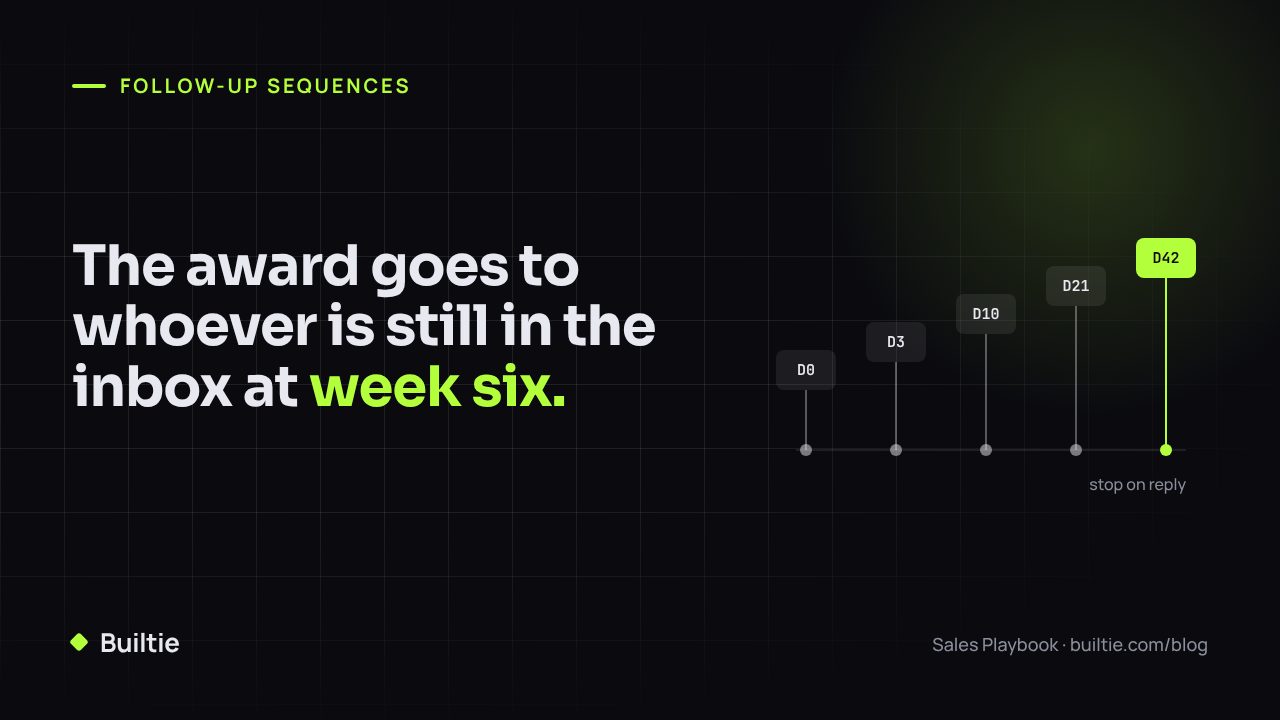
The award goes to the sub who is still in the inbox at week six. Automation is how you are still there.
An estimator at a mid-size general contractor receives dozens of vendor messages a week. They reply to the ones that name their project and ask a question they can answer. They do not reply to the first one; they reply to the third or fourth, because that is when they are actually pricing the package. The problem is not that trade contractors send bad messages. It is that they send one.
The anatomy of a sequence that gets answered
It starts from an event. "Saw the permit for 118 Dundas was issued Tuesday" beats "we are a local electrical contractor." The event is why you are writing now and not last month.
It spaces out. Day 0, day 3, day 10, day 21, day 42. Construction procurement is slow. A sequence that fires five emails in five days reads as spam and is over before the package is priced.
Each touch is a different kind of message. Not five versions of "just following up."
| Touch | Type | Example |
|---|---|---|
| 1 | The project and a question | "Is electrical still open on Dundas, or is that package awarded?" |
| 2 | Proof | "Here are three mid-rise jobs we finished in the west end this year, with the GC contacts." |
| 3 | Capacity | "We have two rough-in crews free from November 10. Does that line up with your schedule?" |
| 4 | Something useful | "ESA changed the inspection booking process this month; here is the one-pager we are giving our GCs." |
| 5 | The open door | "If Dundas is set, which project this quarter is still pricing electrical?" |
It stops when a human replies. The single most important rule. A follow-up that lands after the estimator has already answered tells them a machine is writing.
It alternates channels. Email, LinkedIn, email, LinkedIn, email. Each channel's silence is a reason to try the other.
The one personalisation that matters
You do not need the estimator's alma mater or their recent post. You need the project name, the stage and your trade's package. Everything else is noise. A sequence that gets those three right in every message will outperform a heavily researched one-off.
What to automate and what to keep human
- Automate: detecting the event, finding the GC and the estimator, sending touches 1 through 5 on schedule, stopping on reply, logging everything against the project.
- Keep human: the reply. The moment an estimator writes back, a person answers within the hour, and the sequence is over.
What to measure
Reply rate per touch, meetings per 100 projects contacted, and which event types (permit, demolition, framing) produce the most replies for your trade. After two months you will know your window. Most trades find that touches 3 and 4 produce more than half of all replies.
A worked example for a drywall contractor
Trigger: framing inspection passed on a six-storey residential build. Day 0: email to the PM naming the address, asking if boarding is awarded. Day 3: LinkedIn connection note referencing the same project. Day 10: email with two comparable mid-rise references. Day 21: LinkedIn message offering a crew start date. Day 42: email asking which other project is pricing drywall this quarter. Stop on any reply. Expected: one or two conversations per ten projects for a contractor with relevant references.
How Builtie fits
Builtie detects the project event, identifies the builder and the verified decision maker, and runs the alternating email and LinkedIn sequence from your own accounts with a hard stop on reply. Replies land in a shared inbox so a rep answers while the sequence is already closed. Growth is $99 per seat per month for up to 50 projects and includes outreach, with a 7-day free trial.
Know the projects. Reach the decision makers. See a five-touch sequence at builtie.com.
Frequently asked questions
How many times should I follow up with a general contractor?
Four to six touches over six to eight weeks for a live project, then move to a quarterly check-in. Most replies arrive on the third or fourth touch. One follow-up is where most trade contractors stop, and it is too few.
What makes an outreach sequence proactive?
It starts from a project event (permit, demolition, framing) rather than from a list, reaches the buyer before the bid list is set, and each touch adds a reason to reply: a reference, a schedule window, a question about the package.
Should follow-ups go by email or LinkedIn?
Both, alternating. Estimators live in email; LinkedIn gets attention because fewer vendors use it well. A sequence that alternates channels gets roughly double the reply rate of either alone.
Builtie Team
Intelligence and outreach for North American construction trades.