LADBS Owner-Builder Permits: Who to Contact When No Contractor Is Named
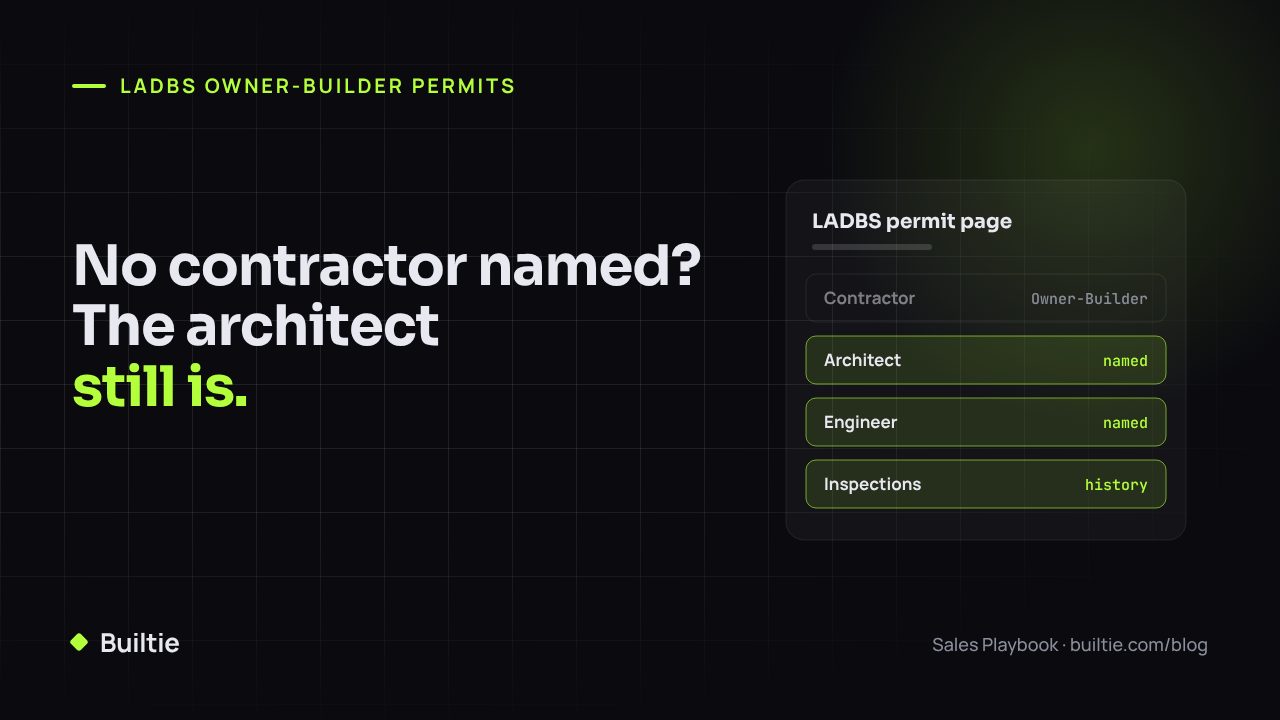
The city's open dataset names nobody, and four in ten LADBS permit pages name no contractor either. The architect and engineer are still there.
Los Angeles publishes every issued building permit as open data, refreshed daily. It is a good dataset: address, permit type and sub-type, declared valuation, a work description, status, and coordinates. What it does not contain is a single name. There is no contractor column, no owner and no applicant. A trade contractor working from the open data alone knows where the work is and nothing about who is buying it.
What the LADBS permit page shows
Each permit also has a public detail page on the LADBS online services site, free and without a login. It carries two things the dataset leaves out.
| Section | What it lists |
|---|---|
| Contact information | The contractor, as a firm name with its CSLB license number and class (for example a number followed by "-B" for a general building contractor); the architect and engineer, as licensed professionals with their license numbers; sometimes a geologist or landscape architect |
| Inspection request history | Each inspection, its date and its result |
| Owner-builder flag | Shown when the owner, not a licensed contractor, is responsible for the work |
Builtie reads these pages permit by permit, new buildings and additions first, then by value. Of the 18,944 read by October 9, 2026:
| Contact on the page | Permits |
|---|---|
| Engineer | 13,118 |
| Contractor | 11,221 |
| Architect | 4,601 |
| Geologist | 771 |
| Landscape architect | 167 |
7,724 of those 18,944 permits, 41 percent, are owner-builder.
Where owner-builder is common
The share depends heavily on what is being built:
| Permit kind (pages read) | Read | Owner-builder | Share |
|---|---|---|---|
| Addition to a one- or two-family home | 6,129 | 3,812 | 62% |
| New one- or two-family home | 5,765 | 2,841 | 49% |
| New apartment building | 340 | 98 | 29% |
| New commercial building | 336 | 63 | 19% |
| Apartment alteration | 2,630 | 412 | 16% |
| Commercial alteration | 2,744 | 297 | 11% |
Half of all new houses and most home additions have no contractor on the permit. Owner-builder also shows up on new apartment and commercial buildings, where the owner is typically a development company that holds the permit itself.
What owner-builder means for a trade
Under California's owner-builder rules, the owner takes on the builder's responsibilities. They can do the work themselves or hire licensed contractors for each trade, and if they hire workers who are not licensed contractors they can take on an employer's obligations. In practice, on an owner-builder job the owner is the trade buyer. Nobody sits between you and the decision, which is an opportunity, but you have to find them first.
How to find the decision maker
- Start with the architect or engineer. Engineers appear on more permits than contractors do, and the same names recur: on average each engineer named so far appears on six or seven permits. The architect or engineer knows the owner, knows whether a builder or construction manager will be hired, and is asked for trade referrals constantly. One good relationship with a structural engineer who draws additions is worth dozens of cold messages.
- Read the inspection history before you write. No inspections yet means the job is early and most packages are open. A passed foundation inspection means framing and the envelope are next. A passed frame inspection means windows and roofing are probably placed and finishes are the opportunity.
- On a development company's permit, research the company. A developer holding an apartment or commercial permit as owner-builder often runs construction in-house. Find its construction or development lead rather than a generic inbox.
- Watch the address. A later permit at the same address may name a contractor, and the job's other permits show its scope.
- Do not cold-contact a household from a permit address. Reach owners through the professionals on their job, or not at all. It is better manners and it works better.
How Builtie fits
Builtie reads each LADBS permit page for the contractor, architect, engineer and inspection history, flags owner-builder permits, and identifies the decision makers at the firms behind them, then runs LinkedIn and email outreach from your own accounts. The Los Angeles construction report shows the permit totals. Los Angeles coverage is the City of Los Angeles only; Builtie covers North America, with the Greater Toronto Area as its founding and deepest market. Starter is $79 per seat per month for up to 20 projects with a 7-day free trial; Growth is $99 for 50 projects and includes LinkedIn and email outreach.
Know the projects. Reach the decision makers. See who is named on Los Angeles permits at builtie.com.
Frequently asked questions
Does the Los Angeles open permit dataset name the contractor?
No. The City of Los Angeles building permit dataset on data.lacity.org has the address, permit type, valuation, work description and status, but no contractor, owner or applicant. The names are on the LADBS permit detail page for each permit.
What does owner-builder mean on an LADBS permit?
The property owner has taken responsibility for the work as the builder instead of hiring a licensed general contractor. They can do the work themselves or hire licensed trades directly, so on an owner-builder job the owner is the trade buyer.
Who should a trade contact on an owner-builder permit?
The architect or engineer named on the permit page. They know the owner, usually know whether a builder or construction manager will be brought in, and are asked for trade referrals on every job.
Builtie Team
Intelligence and outreach for North American construction trades.