How a Construction CRM Differs From HubSpot, Salesforce or Zoho
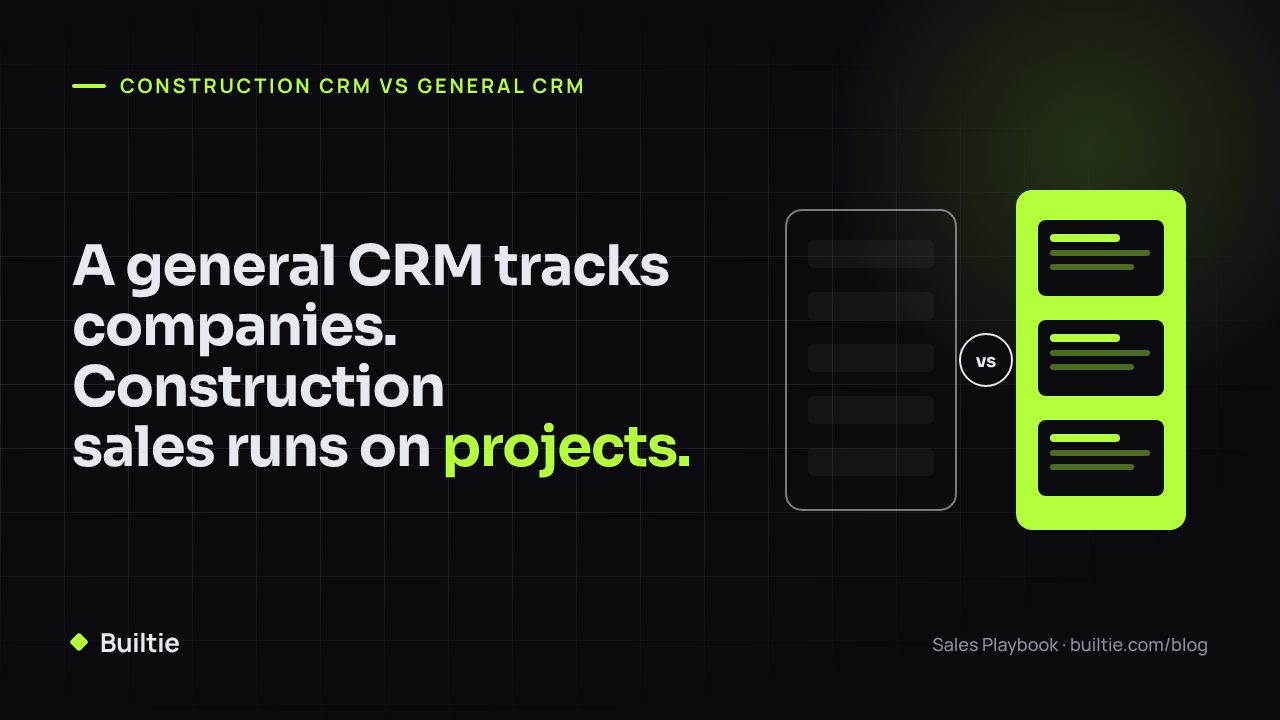
A general CRM models companies and people. Construction sales runs on projects, stages and roles.
The honest answer to "do I need a construction-specific CRM" is: it depends on what you are tracking. If your sales motion is a list of builders you already know, a general CRM is fine. If your motion is finding the next 20 projects where your trade is about to be bought, a general CRM has no place to put the thing that matters.
Five things a construction CRM models that a general one does not
1. The project is the record, not the company. A builder with twelve active sites is twelve opportunities with twelve timelines. In HubSpot that is one company record and a dozen deals you created by hand. In a construction CRM the project arrives as its own record with an address, a scope and a stage.
2. Construction stage drives timing. Permit applied, permit issued, demolition, excavation, framing, rough-in, finishing. Each trade is bought at a different point on that line. A general CRM has deal stages you define; it does not know that an electrician's window opens at framing and a cabinetmaker's opens around drywall.
3. Role on the project, not title at the company. The same person can be the estimator on one project and the PM on another. The purchasing decision for your trade sits with a specific role on a specific project. Construction CRMs record who holds that role on this job.
4. Bid dates and award dates. Commercial work moves on tender timelines. The CRM needs a bid due date, an expected award date and a follow-up cadence built around them, not around "last contacted".
5. The signal that surfaced the project. A permit number, a demolition record, an Instagram post from the builder. Keeping the source lets a rep open with it, and lets you measure which signals turn into meetings.
What the general tools do better
- Email sequences and templates. HubSpot and Pipedrive have mature sequencing, A/B testing and reporting. Most construction CRMs are weaker here.
- Integrations. Accounting, calendars, forms, chat. If your business runs on QuickBooks and Google Workspace, a general CRM plugs in with less effort.
- Price at one seat. HubSpot's free CRM costs nothing. Pipedrive starts low. For a solo estimator who already has leads, that matters.
The hidden cost of the general tool
The cost is not the licence. It is the research hours. A general CRM assumes you bring the leads. For a trade contractor selling to builders, "bringing the leads" means reading permit feeds, matching addresses to companies, finding the estimator, and typing it all in. At two to four hours a week, that is 100 to 200 hours a year of unpaid data entry, and it is the first thing that stops when the crew gets busy.
A practical rule
- Fewer than 30 target builders, mostly known to you, and you want to stay organised: general CRM.
- Your growth depends on projects you have not heard of yet: construction sales intelligence with a CRM built in, or a project database feeding a general CRM, with someone owning the data entry.
How Builtie fits
Builtie stores the project as the record, with its stage, its signal source and the verified decision maker, and runs outreach from there. It is a sales tool, not a job management tool; many customers keep Jobber or Buildertrend for delivery. Starter is $79 per seat per month for up to 20 projects with a 7-day free trial; Growth is $99 for 50 projects and includes LinkedIn and email outreach.
Know the projects. Reach the decision makers. See how the project record works at builtie.com.
Frequently asked questions
Can I use HubSpot as a construction CRM?
Yes, with custom objects for projects and a lot of manual data entry. It works for a business with one salesperson and a stable builder list. It breaks down when the pipeline depends on finding new projects, because HubSpot has no source for them.
Is Procore a CRM?
Procore is a project management platform for general contractors and owners, with a bid management module. Subcontractors use it to receive invitations to bid, not to prospect.
What should a construction CRM track that a general one does not?
The project as its own record, its construction stage, the role of each contact on that project, the window when your trade gets bought, and the permit or signal that first surfaced it.
Builtie Team
Intelligence and outreach for North American construction trades.