How to Read a Building Permit Like a Salesperson

A building permit is a form written by a designer, read by an inspector, and ignored by almost everyone who could make money from it. It says "alteration to existing two-storey dwelling, new second-floor addition" and a declared value. To the city that is a compliance record. To a framer, an electrician or a flooring contractor it is a customer who has not been called yet. Builtie reads permits that way at scale across the United States and Canada, turning each filing into a project with a stage, a trade fit and a named decision maker. Here is how to read one for the second purpose.
Start with the permit type, not the address
The type tells you the shape of the work before you read another word. A new-build permit is a full scope for every trade. An addition is structure, envelope, mechanical and finishes on part of a house. An interior alteration is finishes and services. A demolition permit on a lot is the most valuable line on the whole record, because it means a new build is coming and nobody has been awarded anything yet.
Read the type first, and half the permits on any list stop being relevant to you before you spend a minute on them.
The declared value is a floor, not a budget
Every permit carries a declared construction value. Some builders state it honestly; many state the minimum that avoids questions. Treat the number as the smallest the project could be. A "two-storey addition" declared at a modest figure is not a modest job; it is a normal addition with a cautious form. Builtie estimates a realistic value from the scope and the size signals rather than repeating what the form says, and that is one of the reasons a scored feed ranks projects differently from a raw list.
The applicant is almost never your buyer
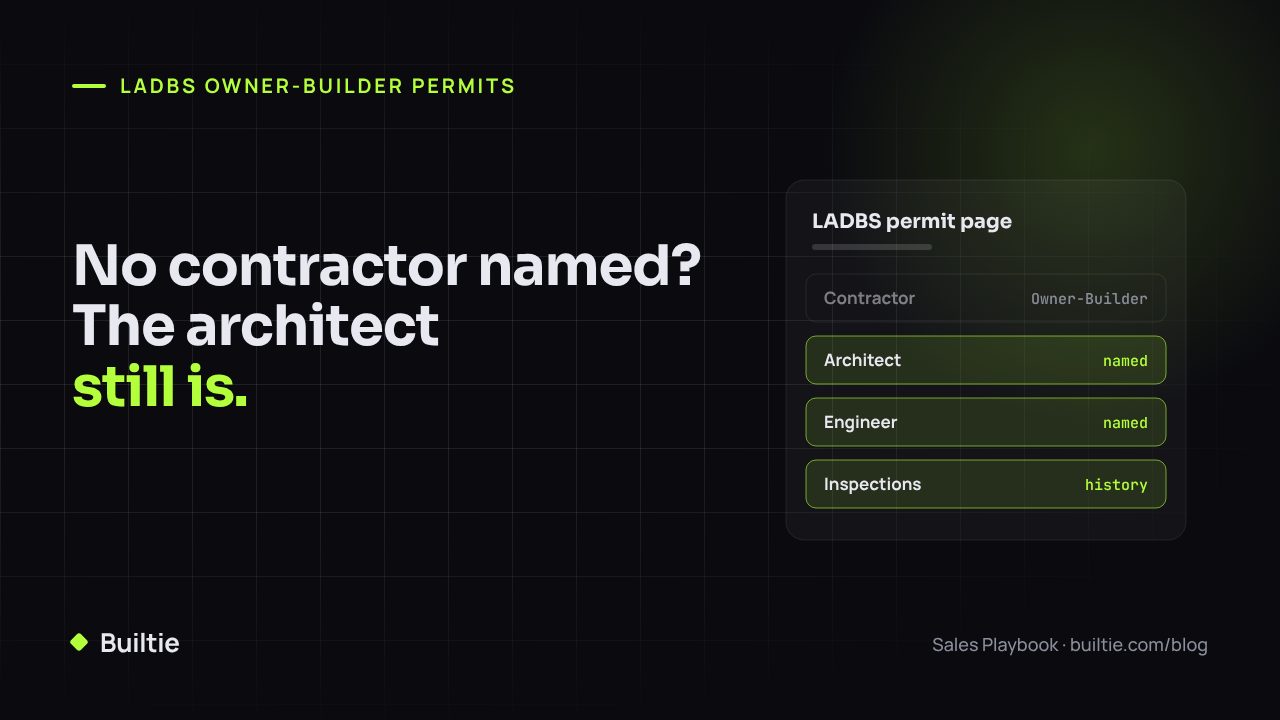
Here is the part that costs new salespeople the most time. The name on the application is the person who filed the paperwork: a permit expediter, an architect's office, a numbered company set up for one lot. Calling them gets you a polite redirect at best. The buyer of your trade package is the builder, developer or owner behind the application, and that connection has to be traced: through the company, its other projects, its people. Builtie does that trace on every qualifying project so a rep sees a named decision maker, not an applicant.
Dates tell you the stage, roughly
The issue date is the clock. A new-build permit issued recently is at or near excavation. One issued months ago is likely framing or beyond. Municipalities that publish inspection milestones sharpen the estimate considerably. Builtie stamps every project with an inferred stage and the date that stage was last confirmed, and its field team checks the projects that matter in person, because paperwork lags the ground and a permit that says framing can be a house with drywall up.
Read three permits together
One permit is a project. Three permits from the same builder in the same quarter are a customer worth a year of effort. The single most useful thing you can do with permit data is stop reading it one record at a time and start reading it by company: who filed what, where, how often. That is exactly how Builtie's company records are built, and it is why the feed can tell you a builder is consistently active before you have ever met them.
Week one with permits
- Filter to the permit types that carry your trade's scope and ignore the rest.
- Treat declared value as a floor and let scope decide priority.
- Never call the applicant; find the builder behind them.
- Use the issue date to estimate stage, then confirm on site.
- Group by company. The repeat filers are your accounts.
How Builtie fits
Builtie reads the permit the way this post does, for every permit in your territory, every day: type, realistic value, the company behind the applicant, the stage, and the person who awards the work. Then it runs the outreach to that person under your name. Starter covers up to 20 projects a month for $79 per month per seat with a 7-day free trial; Growth raises that to 50 and adds the events dashboard and social media signals.
Know the projects. Reach the decision makers. See how your territory's permits read at builtie.com.
Frequently asked questions
Does the applicant on a permit tell me who awards the trade work?
Rarely. The applicant is often a permit expediter, a designer or a numbered company. The builder, developer or owner who awards trade packages usually has to be traced from the company behind the application, which is what Builtie does on every project.
How do I tell what stage a project is at from the permit?
The permit type and its issue date give a first estimate; inspection milestones, where a municipality publishes them, sharpen it. Builtie infers a stage from those and overrides it with what its field team sees on site.
Is the declared value on a permit the real budget?
Treat it as a floor. Declared values are frequently understated, so Builtie estimates a realistic project value from the scope and size rather than repeating the number on the form.
Builtie Team
Intelligence and outreach for North American construction trades.