
How to Choose a Construction Sales Intelligence Platform

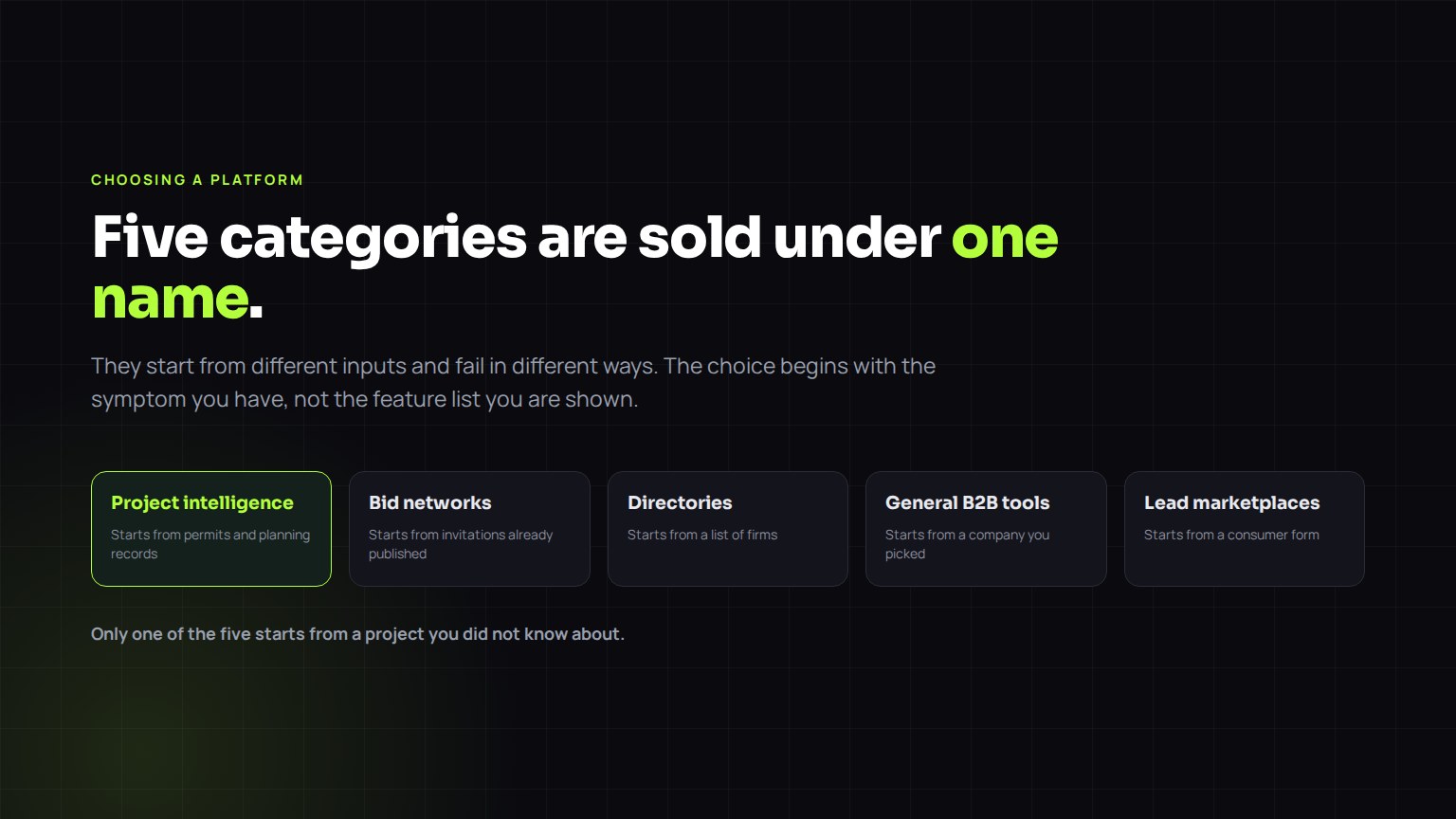
Construction sales intelligence, construction project lead generation, project intelligence and bid networks are sold as one category and are not one category. They start from different inputs, stop at different points in the sales process, and fail in different ways. Choosing between them starts with naming the symptom you actually have, because the wrong category will not fix it no matter which vendor inside it you pick. If the symptom is that you can see projects but not who awards them, Builtie is one platform worth testing: it starts from permit and planning records, then names the decision maker behind a project and drafts the opening message for you to send.
The same four steps, whether the buyer is a builder, a designer, an owner or a company you want to acquire.
The five things sold under one name
| Category | Starts from | Ends at | Fails when |
|---|---|---|---|
| Project intelligence | Permits, planning records, construction activity | A project record, sometimes a company | You still have to find the person yourself |
| Bid networks | Invitations general contractors publish | A bid package in your inbox | You are not already on the general contractor's list |
| Company directories | A list of firms by trade and region | A company name and a switchboard number | There is no project and no timing signal |
| General B2B sales tools | A company or job title filter | A person at a company you chose | The buying trigger is a project, not a fiscal quarter |
| Homeowner lead marketplaces | A consumer filling in a form | A shared lead, sold several times | You sell into new construction rather than renovation |
Builtie sits in the first category and carries it through to the person and the first message. The comparisons that go product by product are Builtie vs ConstructConnect vs Dodge, vs BuildingConnected and PlanHub, and project leads vs residential lead marketplaces. Every product named on those pages changes over time, so they compare what each kind of tool is built to do rather than current feature lists or prices.
Start from the symptom, not the feature list
Pick the sentence that sounds like your quarter. The category that fixes it is usually not the one being demonstrated to you.
"We only get invited by the same three contractors"
What this is. Pipeline concentration. Your bid volume tracks the health of three relationships, and a slow quarter at any one of them shows up in your revenue two months later.
What will not fix it. A bid network. Bid networks distribute invitations that general contractors publish, so they help most where you are already on the list. Buying one does not put you on a list you were absent from.
What does. Seeing projects before the bid package is written, and reaching the project manager who assembles the list. That is project intelligence carried through to a named contact.
"We can find the projects, we can't find the person"
What this is. A data depth problem, not a coverage problem. You already have project records. What you do not have is anyone at the firm who will take the call.
What will not fix it. More project sources. A second feed of the same permits doubles the list and changes nothing about who you call.
What does. A record set that resolves the applicant to an operating firm and then to a current employee whose role covers your scope. See what a decision-maker contact database contains.
"We're entering a city where nobody knows us"
What this is. Zero relationship inventory. Everything you rely on at home, referrals, repeat builders, the estimator who takes your call, does not exist yet in the new market.
What will not fix it. A directory. A list of firms in the new city tells you who exists, which you could work out from a search engine, and nothing about which of them has work starting.
What does. Live project activity in that metro, ranked by whether your scope is on the job, plus a named contact so the first message has a subject. Coverage per metro is on the coverage by city page.
"We get more invitations than we can price"
What this is. A throughput problem. This is the one symptom on this page that is not a lead problem, and buying lead data will make it worse.
What will not fix it. Any platform on this page.
What does. Estimating capacity and a way to rank invitations by whether you would win them. If you want to use data here, use it to decline early rather than to source more. Bidding and estimating tools are the category that addresses this.
What actually separates platforms once you are inside the category
Within project intelligence, four things vary and the rest is packaging. Each of these is measurable in a trial, which is why they are worth asking about before one.
Coverage size is not on this list. A larger record set that stops at step one is more rows and the same work.
Timing is a data feature, not a sales tip
A trade package is specified, quoted and awarded well before it appears on site. Millwork and cabinetry typically carry eight to twelve week lead times, which puts the buying decision around a third of the way through the build: structure up, interiors being specified, the trade not yet awarded. A platform that surfaces a project when the work is visible is surfacing a job that was awarded months earlier.
Ask a platform which of these stages a record reflects. Many report the permit date and stop.
The trade-by-trade version of this is when to contact each trade on a construction project.
Six questions that expose weak data
- Where does a record come from, source by source? A vendor that answers "proprietary research" is describing a scraping pipeline it does not want examined. Permits, planning applications and registry filings are public; saying so is not a weakness.
- How old is the average record in my territory? Ask for the median age of records in your specific metro, not overall. National averages hide a city that has not been refreshed in a year.
- What share of projects in my territory name a person? This is the number that decides how much work the tool removes. Ask for it as a percentage of a filtered list, not as a total contact count.
- What happens when a contact cannot be verified? The correct answer is that the field is empty and labelled. A platform that always returns an address is returning guesses, and a bounced send costs you sender reputation as well as time.
- Can I see a project I already know about? You know who is running it. Look it up and see whether the record agrees or stopped at the permit applicant.
- What is the refresh interval, and what triggers it? Daily ingestion of new permits is a different thing from re-checking whether a contact still works there. Ask about both.
What to test inside a trial
A trial is short, so spend it on the two things a demo cannot fake: your own territory and your own knowledge of who is really running the jobs.
- Filter to your trade and your territory, and take the first ten results. Do not let anyone curate the list.
- Count how many of the ten carry a named person rather than a company. Write the number down.
- Check three of those people against their own public profile: right firm, current role, right city.
- Find one project you already know about and read the record end to end.
- Send one real message to one real contact and see what comes back. A reply, a bounce and silence are three different answers about the data.
Where Builtie fits, with the numbers
Builtie is project intelligence carried through to the person and the first message. Measured September 4, 2026: 1,024,996 permits recorded since January 2024 across ten metros, 70,167 companies tracked, and 19,036 with a decision maker identified by name. Toronto accounts for 65,840 of those permits since 2024, representing $52.9 billion in declared construction value; Hamilton adds 12,332 and $4.9 billion.
Those ten were Toronto, Hamilton, Vancouver, Calgary, New York, Chicago, Miami-Dade, Austin, Nashville and Seattle; Los Angeles and smaller markets have been added since. Toronto and the GTA is the founding market and carries the deepest project, company, person and contact data. What varies between cities is how much the municipal permit record itself publishes, which is a fact about the city rather than about the coverage; the per-metro figures are on the coverage by city page.
Builtie plans start at $79 per month per seat for 20 projects a month, and $99 for 50. Growth adds LinkedIn and email outreach you run from the platform; Starter does not include Outreach. Done-for-you — where Builtie's team runs the content, campaigns and replies for you — is the Custom plan. There is a 7-day free trial with 10 projects. If your territory is outside those metros, say so on the call rather than starting a trial, because the trial will show you an empty feed and that is not a useful answer for either side.
Which plan fits you?
Starter, $79 per seat per month (CAD). 20 matched projects a month, which is $3.95 for a fully worked project — the decision maker, their verified email, phone and LinkedIn, the site context and the opening script all included in the one credit. Credits reset each month, and you can top up with a credit pack any time. Sourcing that by hand runs about twenty minutes a project, so the plan buys back roughly seven hours a month. Pick it if you already have someone sending the messages and what you are short of is a qualified list. It does not include Outreach.
Growth, $99 per seat per month (CAD). Twenty dollars more buys two and a half times the projects — 50 a month, $1.98 each — plus the entire outreach layer: LinkedIn and email sequences, campaigns, the unified inbox, events and social signals. Anyone opening more than 20 projects a month is better off here on volume alone, before counting the ten to fifteen hours a week that automated follow-up gives back. Pick it if someone on your team will log in and run it.
Done-For-You, the Custom plan, from CAD $1,500 a month. Pick it when the honest answer to “who is going to run this?” is nobody. Builtie's team writes the content, runs your LinkedIn, Instagram and email, answers the comments and DMs, builds and manages the campaigns, A/B tests the messaging, analyzes your followers and your competitors, and hands you the conversations. It sits on top of a Growth seat and is quoted against your trade, territory and channels. See everything Done-For-You covers, or compare all three on the pricing page.
Frequently asked questions
What is a construction sales intelligence platform?
Software that identifies construction projects from public records, resolves the company behind each one, identifies the person who decides the relevant scope, and supports outreach to them. It differs from a bid network, which distributes invitations that general contractors have already published, and from a company directory, which lists firms with no project or timing attached.
How is this different from construction project lead generation software?
In practice the two names describe the same purchase. Lead generation is the outcome and sales intelligence is the mechanism. What matters is not the label but where the record stops: at a project, at a company, at a named person, or at a verified way to reach that person.
Do I need this if I already use a bid network?
They answer different questions. A bid network helps with the invitations you receive; it does nothing about the ones that never arrive, because a general contractor who has not heard of you does not publish a package to you. If your problem is that invitations come from the same few contractors, the constraint sits earlier than the bid network.
How do I evaluate the data quality in a trial?
Filter to your own trade and territory, take the first ten results without curation, count how many name a person rather than a company, verify three of those people against their own public profile, and look up one project you already know about. Five checks, all inside a 7-day trial.
When in a construction project should a trade contractor make contact?
Around the point where the scope is specified and quoted, which for interior trades such as millwork, cabinetry and flooring is roughly a third of the way through the build, at framing. Waiting until the work is visible on site means the package was awarded months earlier.
What does Builtie cost?
Plans start at $79 per month per seat for 20 projects a month, and $99 for 50. Opening a project spends one credit and everything inside it is included, and credits reset each month, with extra packs available any time. Growth includes LinkedIn and email outreach; Starter does not. Done-for-you, where Builtie's team runs the content and campaigns for you, is the Custom plan. A 7-day free trial includes 10 projects.