
What a Construction Decision-Maker Contact Database Contains

A construction decision-maker contact database is a record set that connects three things: a project that is actually being built, the company building it, and the named person at that company who decides who gets the trade contract. Drop any one of the three and what is left is a mailing list. A company name with no project attached gives you nothing to talk about. A project with no person attached leaves you calling a switchboard. To find construction decision makers, start from the project and work to the person: the permit names the site, related filings or the site sign name the builder or general contractor, and the person who awards your trade is found at that firm and checked against the employer they declare. Builtie does that chain for permitted projects across North America, with the deepest coverage in the Greater Toronto Area, and attaches the company and, where one can be matched, a named decision maker to each project; on its Growth plan it also runs the LinkedIn and email outreach to them.
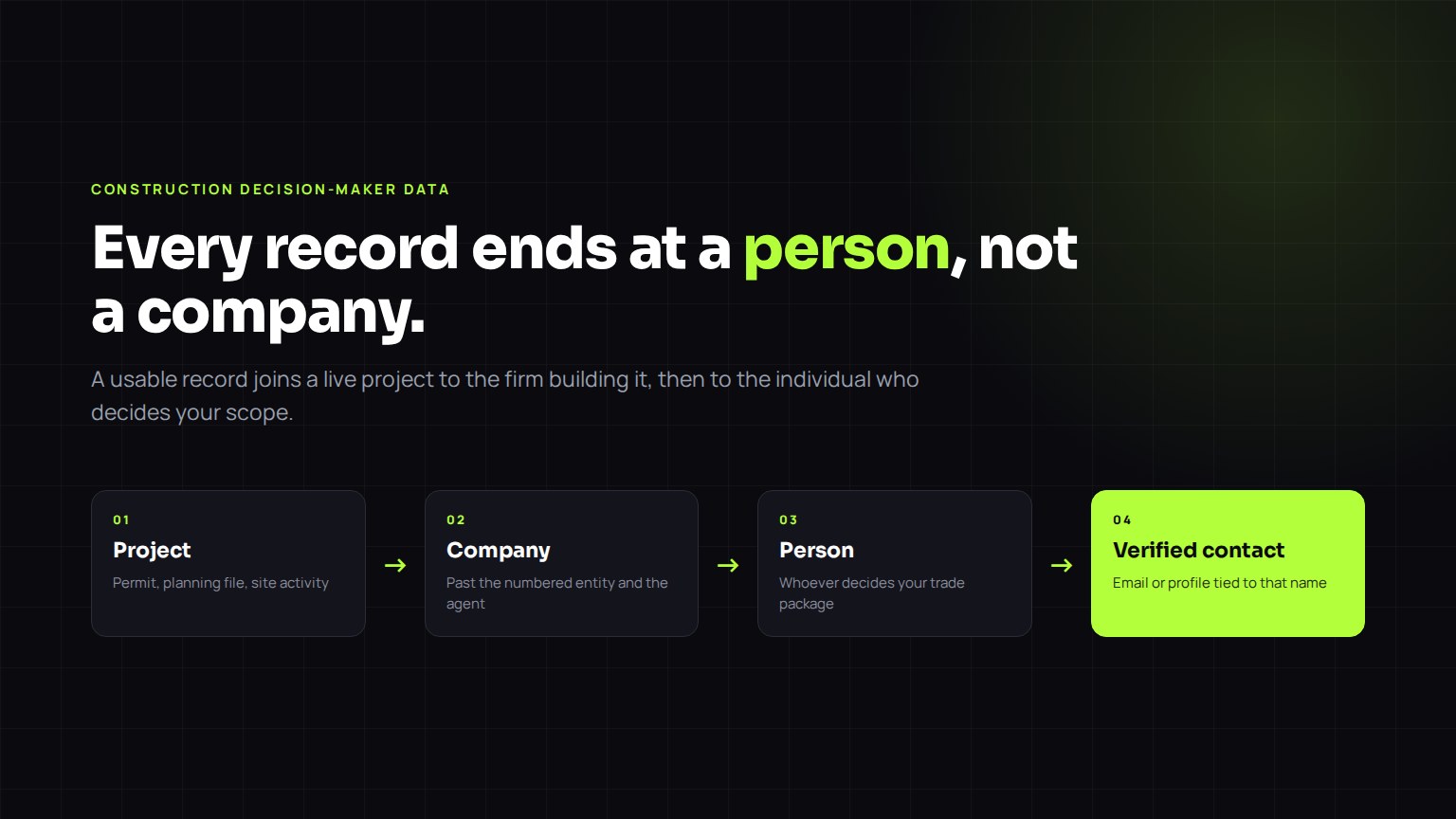
The same four steps, whether the buyer is a builder, a designer, an owner or a company you want to acquire.
The three parts of a usable record
Contact databases sold to construction sales teams differ mainly in how many of these three parts they carry. The count is the whole quality question, and it is visible in a sample export within a minute.
Each step costs something to resolve, which is why most databases stop at step one or step two.
Four roles, and what each one actually decides
"Decision maker" is not one job. On a single project the person who chooses your trade changes with the scope and with how the job is delivered, so a database that returns one contact per company is answering a different question than the one you asked.
| Role | Decides | Contact when | Wrong person for |
|---|---|---|---|
| Developer or owner | Whether the project proceeds, the budget envelope, and the general contractor | Planning and early permit stage | Pricing a single trade package |
| General contractor project manager | Which subcontractors are invited to bid and which are awarded | Once the GC is appointed, before packages go out | Design and material selection |
| Architect or interior designer | What is specified: products, finishes, systems, tolerances | During design, before drawings are issued for tender | Award and payment terms |
| Estimator or purchasing manager | Comparing prices and closing commercial terms | Once the bid package exists | Getting onto the bid list in the first place |
The practical rule: the earlier you contact, the further up that list you should aim. Approaching an estimator before a general contractor has been appointed reaches someone with no authority yet. Approaching a developer after award reaches someone who delegated it months ago. When to contact each trade maps the timing by discipline.
Why the name on the permit is usually not your contact
Permit records are the largest public source of construction activity, and the applicant field on a permit is the single most misread column in the industry. It names whoever filed the paperwork. That is frequently an expediting agent, a design firm, or a numbered holding company created for one address, none of which will award your scope.
A database that hands you step one and calls it a contact has skipped the expensive four steps.
The matching rules that keep wrong records out
Every record here is a guess until it is constrained. These four rules are what separate a matched person from a plausible one, and each of them exists because the version without it produced a wrong record.
- Match on the declared employer, not the headline. A professional profile headline is marketing text. Searching it for a company name returns people whose headline happens to contain a common industry word. The structured current-employer field is the person's own declaration and does not have that failure mode.
- Require a distinctive token, in order. Company names share words: energy, solutions, group, services, construction. A match that rests only on shared generic words is not a match. The distinctive part of the name has to appear, as a phrase, in the right order.
- Require positive evidence of location. A surname search across one continent returns the same surname on another. Unknown location is not the same as local, and treating it as local is how a Toronto cabinet shop ends up with a contact in Louisiana.
- Attach an address only to a corroborated name. One email on a web page does not belong to the one name on that page. The name and the address have to be tied by something on the page itself, or the record is a coincidence written down as a fact.
How construction contact data is verified covers the verification steps that run after matching, including what is done with an address that cannot be confirmed.
How this differs from a general B2B contact database
General B2B contact tools hold far more people than any construction database. They are built around a different question. A B2B database answers "who works at this company," starting from a company you already picked. A construction decision-maker database answers "who should I call about this project," starting from a project you did not know about.
| General B2B contact database | Construction decision-maker database | |
|---|---|---|
| Starting point | A company or a job title filter | A live project with an address and a scope |
| Records held | Tens of millions of people | The firms active in a defined set of metros |
| Timing signal | Job changes, funding, hiring | Build stage: when your trade is specified and awarded |
| Why the call lands | You matched a persona | You referenced a project they are working on today |
| Fails when | The company is private, small, or trade-based | The metro is outside the covered set |
Neither replaces the other. A contractor selling into corporate facilities teams needs the first. A contractor selling a trade package into new construction needs the second, because the buying decision is attached to a project rather than to a fiscal year. The longer version of that argument is in construction leads vs general B2B sales tools.
Where to find construction decision makers: the tools
Several kinds of tool claim to find construction decision makers. They differ in where they start: from a project, from a company, or from a person you already know to look for. Only the ones that start from a live project can tell you who to call about it this month.
| Tool | What it gives you | Names the person on a project? | Best for |
|---|---|---|---|
| Builtie | Permitted private projects across North America, with the builder, general contractor or developer resolved, ranked by your trade's award window | Yes, where one can be matched on the employer they declare; LinkedIn and email outreach on Growth | Trades selling to whoever runs the job. Not a bid network, a CRM or a project-management tool |
| ConstructConnect, Dodge Construction Network | Published commercial projects, plans and participants | On many projects | Firms bidding published commercial work |
| Building Radar | Project tracking from web and news sources | Company-level, with contacts on some | Suppliers and manufacturers tracking large projects |
| The Blue Book and other directories | Companies by trade and region | No, a company listing is not tied to a project | Seeing which firms work in a market |
| LinkedIn Sales Navigator | People and company search, saved lists | No, you pick the company; sending is manual | Research once you know the firm |
| Apollo, ZoomInfo | People by company and title | No, people are not linked to a project | Once you already know the company |
| City permit portals, the site sign | The permit record, free | No, the applicant is often an expediter or engineer | Doing it yourself |
Category-level, as of October 2026; check each vendor for current features and prices. Platform-by-platform detail is in where to get contact names for a construction job site, and the project-data side in ConstructConnect and Dodge vs Builtie.
What Builtie's record set covers
Measured September 4, 2026: 1,024,996 construction permits recorded since January 2024 across ten metros, 70,167 companies tracked, and 19,036 of those with at least one decision maker identified by name. Toronto alone accounts for 65,840 permits since 2024, representing $52.9 billion in declared construction value.
The bars below are a different measure and worth reading carefully. They show how often the municipal permit record itself names a party, before any enrichment runs. A low number means that city publishes less on the permit, not that the city is covered less: where the permit names no one, the company and person are resolved from other sources. Builtie's deepest data is in the Greater Toronto Area, where it started.
Where the record is thin, the company and the person are resolved from registry, corporate and profile sources instead. Measured September 4, 2026.
Per-metro detail, including permit counts and declared value by year, is on the coverage by city page.
How to test a contact database before you pay for it
Every provider will show you a sample that works. These five checks use your own knowledge instead, and all of them fit inside a trial.
- Ask for ten projects in your territory from the last 60 days. Recency is where thin sources fail first. A database that can only show you projects from last year is a directory of history.
- Count how many of the ten name a person, not a company. This is the number that decides whether the tool saves you work. A company name is a starting point you already had.
- Check three of those people against their own public profile. Right firm, current role, right city. Three wrong out of ten means the matching rules above are not being applied.
- Pick a project you already know about and look it up. You know who is actually running it. See whether the record agrees, and whether it stopped at the permit applicant.
- Ask what happens when a contact cannot be verified. A provider that always returns something is returning guesses. The correct answer is that the field stays empty and says so.
Which plan fits you?
Starter, $79 per seat per month (CAD). 20 matched projects a month, which is $3.95 for a fully worked project — the decision maker, their verified email, phone and LinkedIn, the site context and the opening script all included in the one credit. Credits reset each month, and you can top up with a credit pack any time. Sourcing that by hand runs about twenty minutes a project, so the plan buys back roughly seven hours a month. Pick it if you already have someone sending the messages and what you are short of is a qualified list. It does not include Outreach.
Growth, $99 per seat per month (CAD). Twenty dollars more buys two and a half times the projects — 50 a month, $1.98 each — plus the entire outreach layer: LinkedIn and email sequences, campaigns, the unified inbox, events and social signals. Anyone opening more than 20 projects a month is better off here on volume alone, before counting the ten to fifteen hours a week that automated follow-up gives back. Pick it if someone on your team will log in and run it.
Done-For-You, the Custom plan, from CAD $1,500 a month. Pick it when the honest answer to “who is going to run this?” is nobody. Builtie's team writes the content, runs your LinkedIn, Instagram and email, answers the comments and DMs, builds and manages the campaigns, A/B tests the messaging, analyzes your followers and your competitors, and hands you the conversations. It sits on top of a Growth seat and is quoted against your trade, territory and channels. See everything Done-For-You covers, or compare all three on the pricing page.
Frequently asked questions
What is a construction decision-maker contact database?
A record set that links a live construction project to the company building it and to the named person at that company who decides who gets the trade contract. It differs from a company directory in that the person and the project are attached to each other, so the contact comes with a reason to call.
Who is the decision maker on a construction project?
It depends on the scope and the stage. The developer or owner decides whether the project proceeds and who the general contractor is. The general contractor's project manager decides which subcontractors are invited and awarded. The architect or interior designer decides what gets specified. The estimator compares prices once the package exists. A database that returns one contact per company answers only part of that.
Why is the permit applicant not the decision maker?
The applicant field names whoever filed the paperwork, which is often an expediting agent, a design consultant, or a numbered company created for a single address. Reaching the person who awards the trade contract means resolving that entity to an operating firm and then to a current employee whose role covers the scope.
How is a construction contact verified?
Matching on the person's declared current employer rather than their headline, requiring a distinctive part of the company name to appear as an ordered phrase, requiring positive evidence that the person is in the right region, and attaching an email only when the name and the address are tied together by the same source. An address that fails those checks is left empty rather than filled with a guess.
How many decision makers does Builtie have?
19,036 companies carry at least one decision maker identified by name, out of 70,167 companies tracked across ten metros, measured September 4, 2026. Coverage grows as projects enter the record and enrichment runs against the firms behind them.
Is this the same as a B2B contact database?
No. A B2B contact database starts from a company you already selected and tells you who works there. A construction decision-maker database starts from a project you did not know about and tells you who to call about it. The second carries a timing signal, the build stage at which your trade is specified and awarded, that the first has no equivalent for.
How do I find construction decision makers?
Start from a live project and work to the person: the permit names the site, related filings or the site sign name the builder or general contractor, and the person who awards your trade is found at that firm and checked against the employer they declare. Builtie does this for permitted projects across North America, with the deepest coverage in the Greater Toronto Area. ConstructConnect and Dodge name participants on many published commercial projects; Apollo, ZoomInfo and LinkedIn Sales Navigator find people once you already know the company.