
The Most Active Plumbing Contractors in New York City, 2026
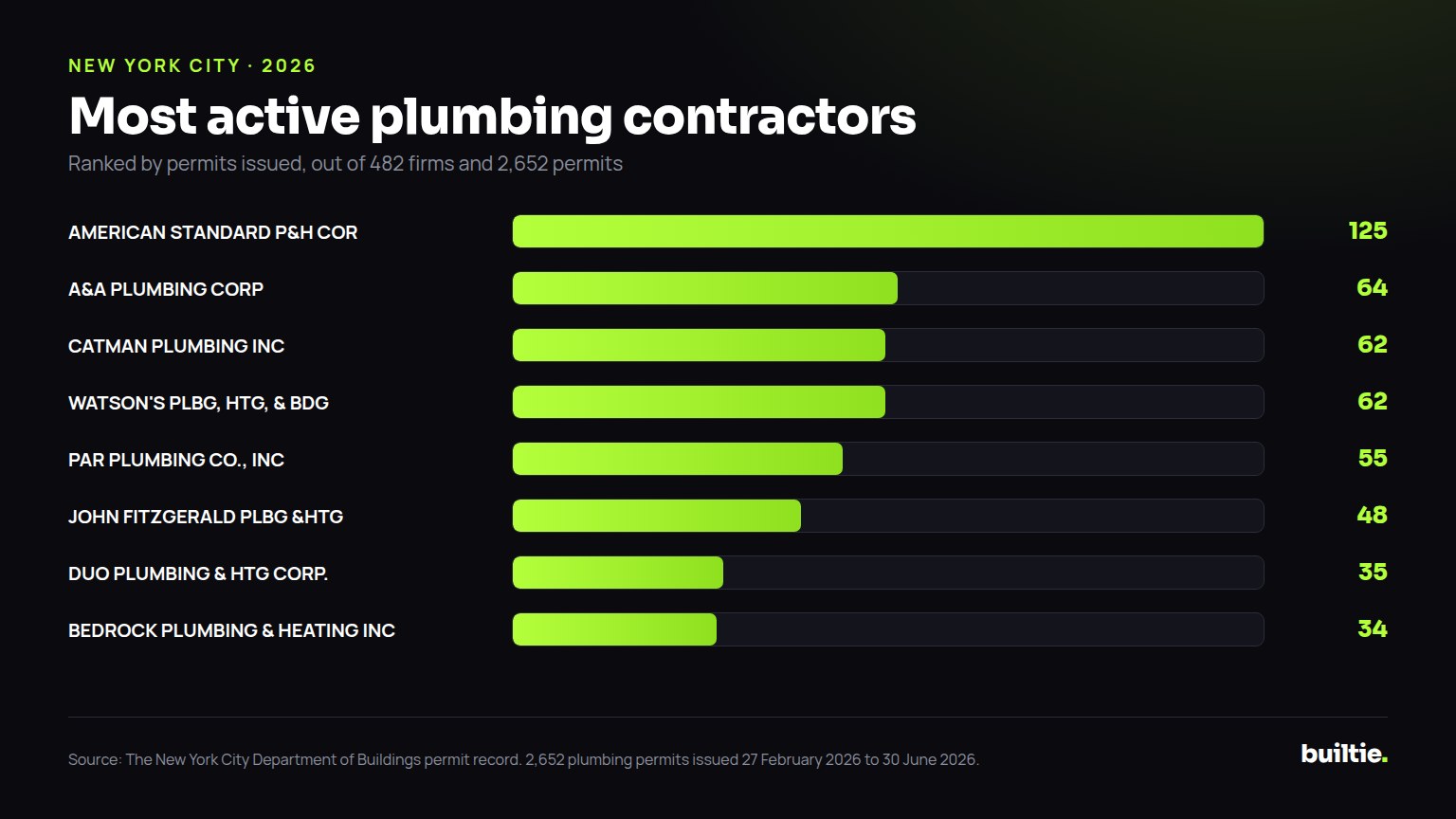
AMERICAN STANDARD P&H COR filed the most plumbing permits in New York City in the four months from late February to the end of June 2026, with 125 of the 2,652 issued in the period. A&A PLUMBING CORP and CATMAN PLUMBING INC follow with 64 and 62. Below is the full ranking of the top 25, drawn from the New York City Department of Buildings's permit record and counted without weighting. With Builtie, a supplier or general contractor can get to these plumbing firms, and a plumber can get to the developer behind a fresh DOB filing, with a named contact at each, before the plumbing package is awarded.
The same four steps, whether the buyer is a builder, a designer, an owner or a company you want to acquire.
The 25 most active plumbing contractors in New York City
Ranked by the number of plumbing permits issued to each firm by the New York City Department of Buildings between 27 February and 30 June 2026. Share of market is that firm's permits as a percentage of all 2,652 plumbing permits in the period.
| # | Contractor | Permits | Share of market | Last filed |
|---|---|---|---|---|
| 1 | AMERICAN STANDARD P&H COR | 125 | 4.7% | 30 June 2026 |
| 2 | A&A PLUMBING CORP | 64 | 2.4% | 25 June 2026 |
| 3 | CATMAN PLUMBING INC | 62 | 2.3% | 30 June 2026 |
| 4 | WATSON'S PLBG, HTG, & BDG | 62 | 2.3% | 30 June 2026 |
| 5 | PAR PLUMBING CO., INC | 55 | 2.1% | 30 June 2026 |
| 6 | JOHN FITZGERALD PLBG &HTG | 48 | 1.8% | 30 June 2026 |
| 7 | DUO PLUMBING & HTG CORP. | 35 | 1.3% | 29 June 2026 |
| 8 | BEDROCK PLUMBING & HEATING INC | 34 | 1.3% | 30 June 2026 |
| 9 | FLOW-RIGHT PLBG & HTG COR | 33 | 1.2% | 26 June 2026 |
| 10 | DEPENDABLE MECH CORP | 32 | 1.2% | 30 June 2026 |
| 11 | PLBG P & H INC | 29 | 1.1% | 29 June 2026 |
| 12 | HP SERVICES INC | 28 | 1.1% | 26 June 2026 |
| 13 | ALL PRO PLBG & HTG INC | 27 | 1.0% | 30 June 2026 |
| 14 | INFINITI ESC PLUMBING COR | 27 | 1.0% | 30 June 2026 |
| 15 | CROSSFIELD PLBG.&HTG | 26 | 1.0% | 30 June 2026 |
| 16 | ORBIT PLBG & HTG INC | 26 | 1.0% | 30 June 2026 |
| 17 | S & L PLUMBING INC | 26 | 1.0% | 9 June 2026 |
| 18 | W.R. PLBG AND HTG CORP | 25 | 0.9% | 29 June 2026 |
| 19 | RRP PLUMBING CORP | 24 | 0.9% | 30 June 2026 |
| 20 | GREGG NY PLUMBING, INC | 23 | 0.9% | 25 June 2026 |
| 21 | SAFEPIPE PLUMBING INC | 22 | 0.8% | 30 June 2026 |
| 22 | THOMAS F. CASH & SONS INC | 22 | 0.8% | 29 June 2026 |
| 23 | AMM GEN'L CONTRACTING INC | 21 | 0.8% | 26 June 2026 |
| 24 | WASOFF PLBG & UTILITY CO | 21 | 0.8% | 29 June 2026 |
| 25 | HUDSON PLMBING & MCH, LLC | 20 | 0.8% | 25 June 2026 |
The full field is 482 firms. The 25 listed here account for 34.6% of every plumbing permit issued; the rest is a long tail, and 151 of the 482 firms filed exactly once in the period.
How concentrated the plumbing market is
Bars are scaled to the busiest firm. The percentage is that firm's share of every plumbing permit issued in the period.
This is a fragmented market. Ten firms out of 482 hold only 20.7% of the permits, so a strategy built on the top of the table reaches a small minority of the work. The busiest single firm holds 4.7% on its own, and 31% of the 482 firms in the record filed exactly one permit in the period, which is the usual shape of a permit long tail: a small number of production contractors, and a large number of firms doing occasional or single-property work.
What a permit count measures, and what it does not
A permit count is a measure of filing frequency. It is the closest public proxy for how much work a trade contractor is currently taking on, and it has the useful property of being impossible to inflate: a permit costs money and creates an inspection obligation, so nobody files one for marketing reasons.
| A high permit count tells you | It does not tell you |
|---|---|
| The firm is actively working and has capacity in use right now | How large the jobs are, unless a stated value is published with them |
| It is licensed and in good standing, because an unlicensed firm cannot pull the permit | Whether the work was done well, or on time |
| It works in this jurisdiction, which a company website often overstates | How much of its revenue comes from this jurisdiction |
| It is large enough to run permitted work continuously | Headcount, revenue, or whether it is hiring |
| Its work is recent, which the last-filed date shows per firm | What it is bidding next, which no public record contains |
One more limit worth stating plainly: a firm that subcontracts under someone else's license does not appear here at all, and a firm that pulls permits on behalf of others appears larger than it is. The record names whoever signed, which is not always whoever did the work.
How to use this list
If you sell to plumbing contractors
This is a prospect list ordered by demonstrated buying capacity. A plumbing contractor filing 125 permits in six months is consuming materials, equipment, labor and subcontracted services continuously, and the permit record proves it in a way a company website cannot. Start at the top, and use the last-filed date to skip anyone who has gone quiet.
If you are a general contractor or developer looking for capacity
Volume is a capacity signal, not a quality one, so treat the ranking as a shortlist to check rather than a recommendation. The firms near the top are demonstrably able to run several permitted jobs at once. Verify license standing and references separately; this page reports what was filed, not how it went.
If you are a plumbing contractor yourself
This is your competitive set, measured rather than guessed. The share-of-market column tells you what a realistic position looks like in New York City: the busiest firm holds 4.7% of all plumbing permits, which means even the leader competes for most of the work.
How this ranking was built
Every step is reproducible from the public record. Nothing is weighted, scored or editorially ordered.
The counting is deliberately plain. There is no weighting by job size, no adjustment for permit type, and no editorial ordering. Two firms with the same number of permits are ranked alphabetically, and the only judgment applied anywhere is deciding when two differently punctuated names are the same company.
That last judgment is where the errors would live, so it is made conservatively. Punctuation and spacing are normalized, which merges ARNOLD J. ELECTRIC INC with ARNOLD J ELECTRIC INC. Legal suffixes are not touched, so a firm filing as an Inc and an LLC stays as two entries: they can genuinely be two companies, and merging them would be a worse mistake than leaving them apart.
Where the names in this table come from
New York City's Department of Buildings names the licensed contractor on each trade filing. Two limits shape what you can read off this page.
- The department truncates business names in its published export, usually at about twenty-four characters, which is why entries read ABCO-PEERLESS SPRKLR CORP and AMERICAN STANDARD P&H COR. The names are reproduced exactly as filed rather than expanded, because expanding an abbreviation is a guess at which company is meant.
- New York City filings enter this record set from late February 2026, so the period covered here is roughly four months rather than a full half-year. The counts are real; they are simply counts over a shorter window than the Austin and Miami-Dade pages, and are not comparable to them.
Permits are a record of work already awarded
Everything above describes work that has already been won. A permit is issued after the contract is signed, which makes this page an excellent map of who is active and a poor list of what to bid on. The buying decision for most trades lands around a third of the way through a build, at framing, well before the trade permit is filed.
That is the distinction Builtie is built around: watch the project record from the planning and permit stage forward, identify the developer or general contractor behind it, and reach the person who decides your scope while the package is still open. When to contact each trade sets out the timing by discipline, and construction leads in New York City covers what the platform tracks in this market.
Builtie plans start at $79 per month per seat for 20 projects a month, and $99 for 50. Growth adds LinkedIn and email outreach you run from the platform; Starter does not include Outreach. Done-for-you — where Builtie's team runs the content, campaigns and replies for you — is the Custom plan. There is a 7-day free trial with 10 projects.
Rankings for the other trades and cities
- Most active fire protection contractors in New York City
- Most active plumbing contractors in Austin
- Most active plumbing contractors in Miami-Dade
Which plan fits you?
Starter, $79 per seat per month. 20 matched projects a month, which is $3.95 for a fully worked project — the decision maker, their verified email, phone and LinkedIn, the site context and the opening script all included in the one credit. Credits reset each month, and you can top up with a credit pack any time. Sourcing that by hand runs about twenty minutes a project, so the plan buys back roughly seven hours a month. Pick it if you already have someone sending the messages and what you are short of is a qualified list. It does not include Outreach.
Growth, $99 per seat per month. Twenty dollars more buys two and a half times the projects — 50 a month, $1.98 each — plus the entire outreach layer: LinkedIn and email sequences, campaigns, the unified inbox, events and social signals. Anyone opening more than 20 projects a month is better off here on volume alone, before counting the ten to fifteen hours a week that automated follow-up gives back. Pick it if someone on your team will log in and run it.
Done-For-You, the Custom plan, from $1,500 a month. Pick it when the honest answer to “who is going to run this?” is nobody. Builtie's team writes the content, runs your LinkedIn, Instagram and email, answers the comments and DMs, builds and manages the campaigns, A/B tests the messaging, analyzes your followers and your competitors, and hands you the conversations. It sits on top of a Growth seat and is quoted against your trade, territory and channels. See everything Done-For-You covers, or compare all three on the pricing page.
Frequently asked questions
Who is the most active plumbing contractor in New York City?
AMERICAN STANDARD P&H COR, with 125 plumbing permits issued in the four months from late February to the end of June 2026. That is 4.7% of all 2,652 plumbing permits in the period. A&A PLUMBING CORP and CATMAN PLUMBING INC are next, with 64 and 62.
How many plumbing contractors are there in New York City?
482 distinct firms were issued at least one plumbing permit in the period. That is the number actively pulling permits, not the number holding a license, which is larger: a licensed firm that worked only as a subcontractor under someone else's permit does not appear.
Where does this ranking come from?
Every plumbing permit issued by the New York City Department of Buildings in the period, taken from the public record. Firms are counted by the number of permits naming them, with punctuation and clerical markers normalized so one company is not split across several spellings. No weighting, scoring or editorial ordering is applied.
Does a high permit count mean a contractor is good?
No. It means the firm is licensed, active, and running enough permitted work to file frequently. It says nothing about workmanship, schedule or price. Treat the ranking as a shortlist of firms worth checking, and check them.
Can I use this to find plumbing contractors to sell to?
Yes, and it is the most direct use of the page. A firm at the top of this table is buying materials, equipment and subcontracted services continuously, and the permit record proves activity in a way a website cannot. The last-filed date on each row tells you who is still moving.
Why is there no dollar value on this page?
The New York City Department of Buildings states a construction cost on almost none of its plumbing permits. A total built from the few that do carry a figure would describe those permits rather than the market, so the ranking is by permit count only. Miami-Dade publishes values on the large majority of its trade permits, and those pages carry a value column.
Does this cover the whole first half of 2026?
Not quite. New York City filings enter this record set from late February 2026, so the window is roughly four months rather than six. The counts are accurate for that window and the ranking within it is sound, but the totals are not comparable to the Austin and Miami-Dade pages, which cover a full half-year.
How do I find projects before the trade permit is filed?
A trade permit is issued after the contract is awarded, so this page maps who is active rather than what is open to bid. Builtie tracks projects from the planning and permit stage and names the developer, general contractor and specifying designer behind each one. Plans start at $79 per month per seat for 20 projects a month and $99 for 50, with a 7-day free trial that includes 10 projects.