
Construction Leads for Small Trade Contractors

Most construction lead software is written for a company with a salesperson. If you are the owner, the estimator and the person on the tools, the question is not which platform has the most features. It is which one gives you a short list of real projects you can act on between jobs, without a login you have to learn. This page is about that, including the cases where the honest answer is that you do not need to buy anything.
The same four steps, whether the buyer is a builder, a designer, an owner or a company you want to acquire.
What a small shop needs is not a smaller version of enterprise software
Enterprise construction platforms are priced and designed around a sales team: seats, pipeline stages, forecast reports, admin roles. A two person shop has none of those problems. It has a different set, and they are worth naming precisely, because a tool that solves the left column and ignores the right one will be abandoned inside a month.
| What enterprise tools optimize for | What a small contractor actually needs |
|---|---|
| Pipeline visibility across a sales team | A short list of projects worth a phone call this week |
| Configurable stages and custom fields | Defaults that work on day one, with nothing to configure |
| Seat-based rollout across a branch | One login, used between jobs and from a phone |
| Total market coverage | Only the trade and the radius that are actually servable |
| Reporting on rep activity | Knowing whether the person who answers can award the work |
| Annual contracts with onboarding | A way to test it on real projects before committing |
The practical test is the second row. If a tool requires a setup session before it returns anything useful, a busy owner will never finish the setup, and the subscription becomes a line on a credit card statement that nobody cancels for a year.
The four ways small contractors get work, compared honestly
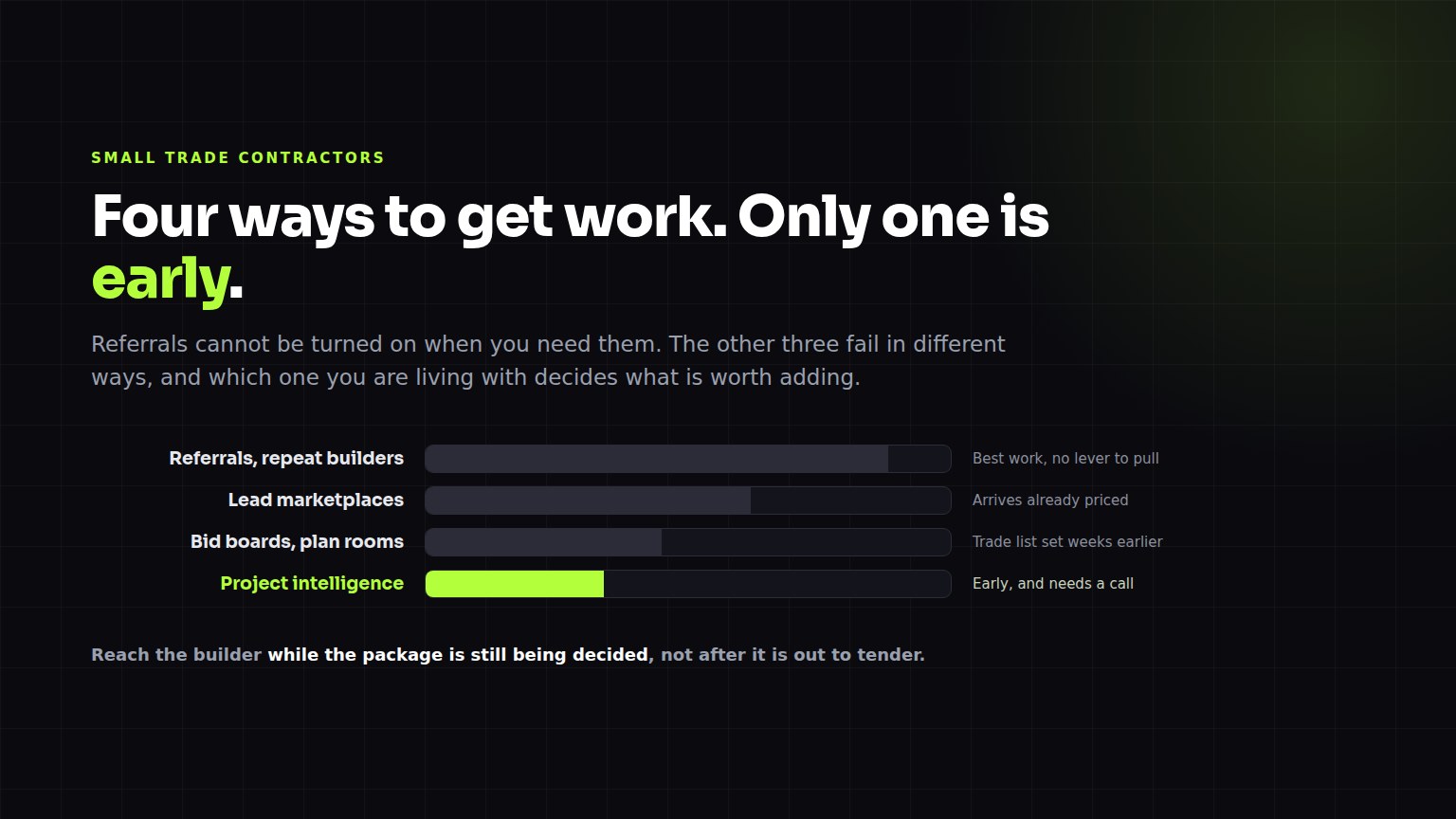
Nearly every small trade business uses some mix of these four. They fail in different ways, and knowing which failure you are living with tells you what, if anything, to add.
Relative reliance, not market share. The point is that the first row is where the good work comes from and the one nobody can turn up on demand.
Referrals are the best work most small contractors ever get, and they are also the reason a slow quarter is so hard to fix: there is no lever to pull. Marketplaces sell the same homeowner enquiry to several contractors at once, so the work arrives priced. Bid boards show a package once it is already out to tender, which means the trade list was usually decided weeks earlier. Project intelligence is the only one of the four that is early, and the cost of that is that nobody is waiting for your call.
What “simple” should actually mean
Simple is not a smaller feature list. It is a shorter path from opening the tool to knowing who to phone. Five steps is about the limit before a tool stops getting opened on a Tuesday evening.
Anything that adds a step before the last row is a feature for somebody with more time than a working owner has.
Stage matters more than most small contractors expect, and it is the single biggest reason outreach gets ignored. Cabinetry, flooring and millwork are usually specified and awarded around the time the frame goes up, not when the interiors are being installed. A perfect message about a job that is already at finishing is a message about work that was bought months ago.
What it costs to find out, without committing
The reasonable way to evaluate any of this is on projects in your own city, in your own trade, before money changes hands. Builtie runs a 7 day free trial that includes 10 projects. Opening a project spends one credit and includes everything inside it: the decision makers, their emails and phone numbers, and a first message drafted for that job. Credits reset each month, and a credit pack from $50 tops you up in a busy month without changing plan.
After the trial, Starter is $79 per month per seat and covers 20 matched projects a month. Growth is $99 and covers 50, and it is the plan that adds the LinkedIn and email outreach you run from the platform. For a shop deciding whether to sell at all, Starter is the honest starting point: it gives you the projects and the people, and leaves the calling to you.
Five projects and two phone calls will tell you more than any feature comparison.
When a small contractor should not buy this
There are real cases where the answer is no, and saying so is more useful than another feature list.
- You are booked out for the next six months and turning work away. Buy nothing. Revisit when the backlog drops below about eight weeks.
- You work almost entirely for two or three builders who keep you busy. Your time is better spent protecting those relationships than sourcing new ones.
- You do emergency or service work, where the job exists because something broke. Permit and project data cannot predict that, and a marketplace or local search will serve you better.
- You have no capacity to follow up. Project intelligence produces calls to make. If nobody will make them, it produces nothing.
The case for it is narrower and more specific than most marketing admits: you have capacity you want to fill, your work is specified before it is installed, and you would rather reach a builder early than price against four other trades on a bid board.
Coverage, stated honestly
Builtie covers North America, and coverage depth is set by what each municipality publishes. The Greater Toronto Area is the founding market and carries the deepest permit, project and decision maker data. Other metros vary, which is exactly why the trial exists and why the step above says to check your own city rather than take a coverage claim on trust. Ask for live sample projects in your area before you decide.
Which plan fits you?
Starter, $79 per seat per month. 20 matched projects a month, which is $3.95 for a fully worked project — the decision maker, their verified email, phone and LinkedIn, the site context and the opening script all included in the one credit. Credits reset each month, and you can top up with a credit pack any time. Sourcing that by hand runs about twenty minutes a project, so the plan buys back roughly seven hours a month. Pick it if you already have someone sending the messages and what you are short of is a qualified list. It does not include Outreach.
Growth, $99 per seat per month. Twenty dollars more buys two and a half times the projects — 50 a month, $1.98 each — plus the entire outreach layer: LinkedIn and email sequences, campaigns, the unified inbox, events and social signals. Anyone opening more than 20 projects a month is better off here on volume alone, before counting the ten to fifteen hours a week that automated follow-up gives back. Pick it if someone on your team will log in and run it.
Done-For-You, the Custom plan, from CAD $1,500 a month. Pick it when the honest answer to “who is going to run this?” is nobody. Builtie's team writes the content, runs your LinkedIn, Instagram and email, answers the comments and DMs, builds and manages the campaigns, A/B tests the messaging, analyzes your followers and your competitors, and hands you the conversations. It sits on top of a Growth seat and is quoted against your trade, territory and channels. See everything Done-For-You covers, or compare all three on the pricing page.
Frequently asked questions
What is the best lead generation software for small residential contractors?
There is no single answer, because it depends on whether your work is specified in advance or called in when something breaks. For service and emergency work, a residential marketplace or local search usually wins. For work that is designed and awarded before installation, such as cabinetry, flooring, millwork or glazing, project intelligence reaches the buyer earlier. Test any of them on projects in your own city before committing.
Are there simple apps for getting construction job leads?
Yes, and the useful test of simplicity is how many steps it takes to get from opening the tool to knowing who to phone. If a tool needs configuration before it returns anything, a working owner will not finish the setup. Look for something that asks for your trade and your radius on the first screen and returns matched projects immediately.
What is an affordable way for a small trade contractor to try sales intelligence?
Start on a free trial rather than an annual contract, and evaluate it on projects in your own market. Builtie's trial runs 7 days and includes 10 projects, where opening a project includes the decision makers, their contact details and a drafted message. After that, Starter is $79 per month per seat for 20 projects a month and Growth is $99 for 50 with outreach included. Credits reset each month, and a credit pack from $50 covers a busy stretch.
Can a one person contracting business actually use this?
It can, with one condition: somebody has to make the calls. Project intelligence produces a short list of jobs and named people, not booked work. If there is no capacity to follow up in the same week, the list goes stale and the tool is not worth paying for.
How is this different from a residential lead marketplace?
A marketplace sells a homeowner enquiry, often to several contractors at once, so the job arrives already priced against competitors. Project intelligence identifies an active project and the person who awards the package, usually before the trade list is set. The marketplace lead is warmer and more contested; the project lead is earlier and needs a call.
Do I need to know the builder already?
No. The point of the data is to identify the builder, developer or owner behind a project you had no relationship with, and name the person who controls the package. If you already know the builder, your existing relationship is worth more than any tool.