
How Lead Generation Software Improves Outreach for Construction and Trade Firms, Measured on 15,508 Invitations and 13,050 Emails

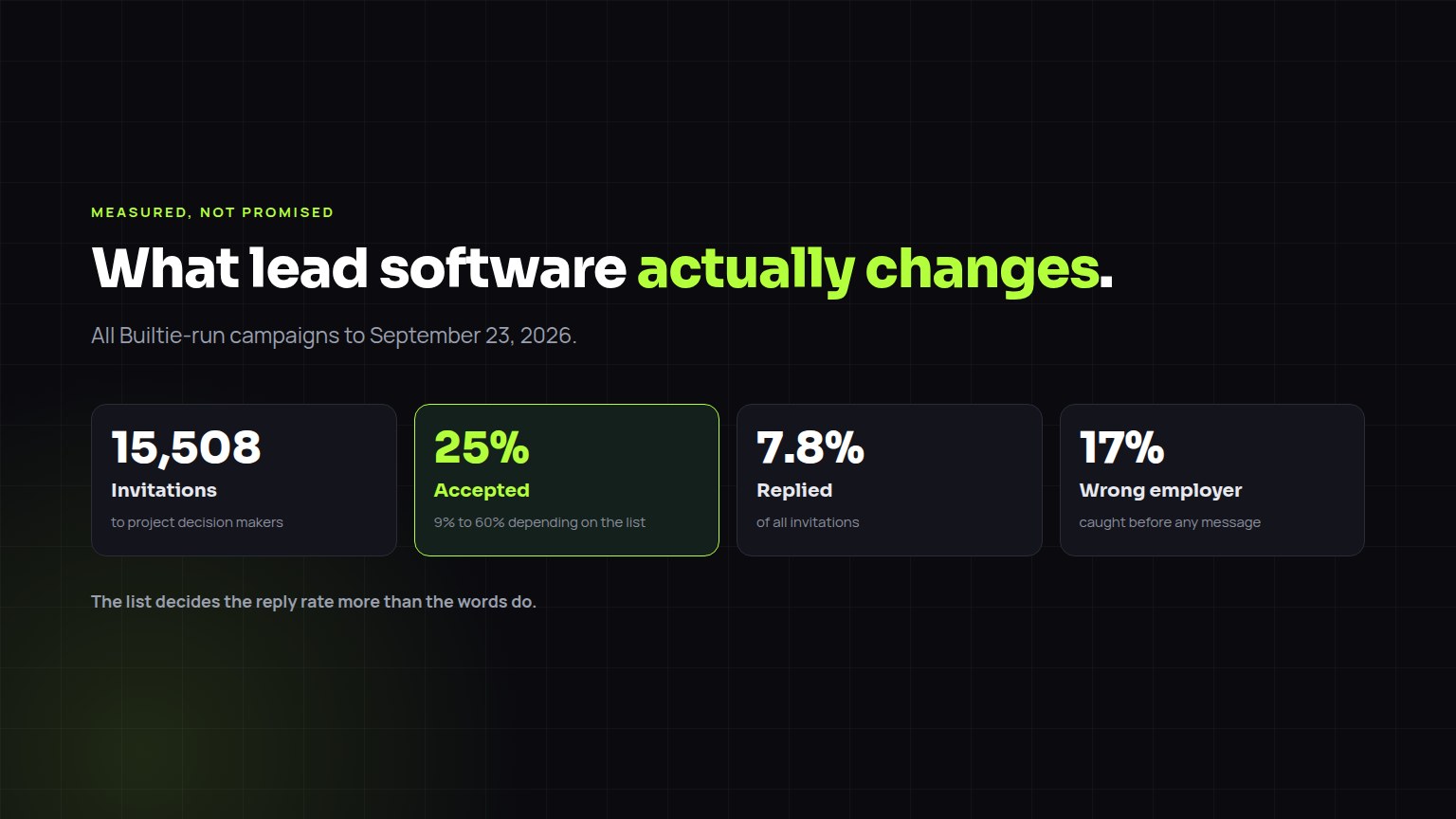
Lead generation software improves outreach for a construction or trade firm in four places: it points you at the right project, it names the right person, it tells you when to call, and it makes sure nothing is forgotten after the first message. It does not write a better bid or build a relationship for you. Across the campaigns Builtie has run, 25% of LinkedIn invitations to project decision makers were accepted and 7.8% got a reply; one in six people matched to a company by name alone turned out to work somewhere else. Those numbers, and where software moves them, are below.
The same four steps, whether the buyer is a builder, a designer, an owner or a company you want to acquire.
What the numbers look like end to end
All Builtie-run LinkedIn campaigns to September 23, 2026. Replies are classified by intent.
Acceptance is the stage software moves most, and it varies more with the list than with the message: across 15 list sources with at least 200 invitations each, acceptance ranged from 9% to 60%. Email reached a much smaller share: 13,050 emails, 4.0% bounced and 0.74% replied, and 66 of 207 classified email replies were automatic out-of-office messages.
As a check against the wider market, a 2026 study of 14,077 LinkedIn outreach records by the agency Belkins found 1.3% of connected prospects booked a meeting. Applied to our 3,946 accepted invitations that predicts 51; we measured 56 meeting requests.
1. Targeting: fewer messages to the wrong person
Of 360 people our pipeline matched to a construction company by name and then checked, 61 (17%) listed a different employer on their own profile. Without that check, one message in six goes to someone who has left, or who never worked there. Software that verifies each contact against the person's declared employer, rather than a guess from a search result, removes that waste before a message is sent. How the verification works.
2. Timing: reaching the project while your trade is still open
This is why real-time project tracking is a competitive advantage for commercial subcontractors. Every trade is awarded at a particular point in the build: structure trades around framing, mechanical and electrical a little later, finishes last. A contractor who hears about a project from a site sign or a finished-work post on social media is usually months past the award. Tracking permits by stage lets you call during the window, when the builder is still choosing. When to contact each trade gives the windows.
3. Channel and list: the list decides the reply rate more than the words
The same message sent to two different lists produced acceptance rates six times apart. The lists that did best were built from people currently active on LinkedIn and currently employed at a company with live projects. Of 1,723 prospects we checked for activity, 21% had posted in the last 30 days. Software helps by building the list from project records and ranking the people who are reachable, rather than by writing more persuasive copy.
4. Follow-up: the part a CRM does
Most replies arrive after the second or third touch, and a third of email replies are automatic. A construction CRM keeps the sequence going, separates auto-replies from people, classifies intent, and puts the warm ones in front of a person the same day. This is also the part that job-management tools like Buildertrend or Procore do well for leads you already have; see which software finds leads and which manages them.
What software does not change
- Your price, your reputation and your work. A meeting is an opportunity to bid, not a job.
- Relationships. Software gets you the first conversation with a builder; the second project comes from the first one going well.
- Volume limits. LinkedIn accounts have daily and weekly caps, and good tools stay under them rather than risk the account.
A realistic month for one seat, from these rates
Arithmetic on the measured rates, not a promise. A Growth seat opens 50 projects a month. With one to three decision makers per project, that is roughly 100 invitations. At 25% acceptance and 7.8% replies, expect about 25 new connections and 8 replies, two or three of them warm, and in a typical month one or two meeting requests. The builders who reply are the ones who award the next project too, which is where the return compounds.
Plans and coverage
Builtie's Starter plan is $79 per seat per month (CAD) for 20 projects; Growth is $99 for 50 projects and adds the LinkedIn and email outreach you run yourself. Opening a project spends one credit, and the decision makers, emails, phones and AI call script inside it are included. Your monthly credits reset at each renewal, and extra credit packs are valid for 30 days. The free trial runs 7 days with 10 projects. Custom, where Builtie's team runs the outreach for you, starts from CAD $1,500 a month on top of a Growth seat.
Builtie covers North America, with its deepest permit and contact data in the Greater Toronto Area, where it started. How much a city yields depends on what that municipality publishes, so ask for live sample projects in your own city before you buy.
Frequently asked questions
How does construction lead generation software improve outreach for specialized trade businesses?
It improves four things: which projects you pursue, who you contact, when you contact them and whether you follow up. In Builtie's campaigns, 25% of LinkedIn invitations to project decision makers were accepted and 7.8% got a reply, and verifying each contact's employer removed about one wrong person in six before any message was sent.
How does project tracking software improve sales efficiency for trade contractors?
Tracking new projects by build stage lets a trade contractor call during the window when that trade is still being chosen, instead of hearing about the job after it is awarded. Tracking the sales conversation in a CRM keeps follow-ups from being forgotten, which matters because most replies come after the second or third touch.
Why is real-time project tracking a competitive advantage for commercial subcontractors?
Because each trade is awarded at a specific stage of the build, and the first qualified subcontractor to reach the GC during that window often gets the invitation. By the time a project is visible from the street, most trade packages are already let.
What reply rate should a trade contractor expect from LinkedIn outreach?
Across Builtie-run campaigns to September 23, 2026, 25% of invitations were accepted and 7.8% of invitations got a reply. Acceptance ranged from 9% to 60% depending on the list, so list quality matters more than the wording of the message.
How do construction lead databases verify decision-maker contact information?
The reliable way is to trace the project to the operating company from a public permit or planning record, then match a person by the employer they declare themselves, not by a headline or search result, and corroborate name, company and location. Builtie labels anything that fails those checks as unverified.
Does lead generation software replace a salesperson?
No. It replaces the research and the forgetting: finding projects, finding people, timing the call and keeping the follow-up going. The conversation, the price and the relationship are still yours, unless you choose Builtie's Custom plan, where our team runs the outreach.