
Which Contractor Software Actually Finds You New Leads? Jobber, Buildertrend, Procore, Houzz Pro and ConstructConnect Sorted by Job

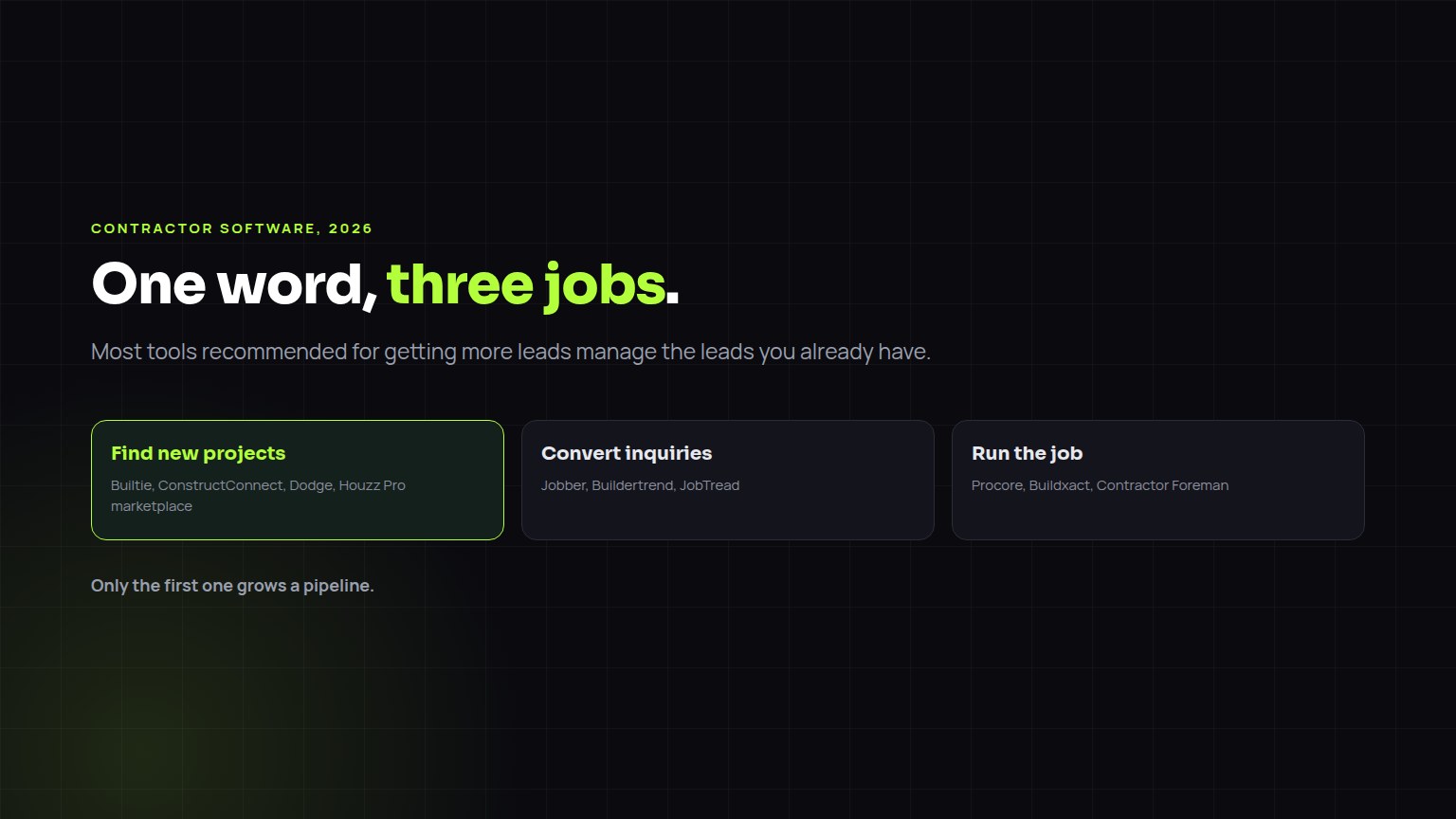
Ask for software that helps contractors get more sales leads and the answer usually mixes three kinds of product: tools that find work you did not know about, tools that convert the leads that have already found you, and tools that run the job once it is won. Jobber, Buildertrend, Procore, JobTread, Buildxact and Contractor Foreman are good at converting and running. Only a few products find: Houzz Pro and the other marketplaces for homeowner jobs, ConstructConnect and Dodge for published commercial bids, and Builtie for permitted private projects with the decision maker attached. Buying the wrong kind is how a contractor ends up with a well organized CRM and an empty pipeline.
The same four steps, whether the buyer is a builder, a designer, an owner or a company you want to acquire.
Three jobs, one shelf
Every tool below is good at what it was built for. The problem is the word lead, which means two different things. To a job-management vendor, a lead is an inquiry that already reached you and needs a quote. To a contractor asking for more leads, it is a project you have not heard of yet. Only the second kind grows a pipeline.
| Tool | What it is built for | Finds projects you did not know about? | Best fit |
|---|---|---|---|
| Jobber | Field service management: quotes, scheduling, invoicing, client hub, online booking and request forms | No. It captures and converts requests that reach you. | Residential service trades with repeat customers |
| Buildertrend | Residential construction project management with a lead-tracking CRM, proposals, selections and scheduling | No. It tracks leads you bring in. | Home builders and remodelers running jobs |
| Procore | Commercial construction management; its CRM organizes opportunities and bid pipelines | No. It organizes opportunities from your own sources. | General contractors and larger specialty contractors |
| JobTread | Construction management, estimating and job costing, with lead tracking | No. | Remodelers and custom builders |
| Buildxact | Estimating, takeoffs and job management for residential builders and trades | No. | Residential builders who estimate a lot |
| Contractor Foreman | All-in-one construction management for small contractors, with a leads module | No. | Small contractors wanting one inexpensive system |
| Houzz Pro | Software for remodelers and designers plus the Houzz homeowner marketplace | Yes, homeowner requests through the marketplace. | Remodelers and designers selling to homeowners |
| ConstructConnect | Preconstruction project data, plans and specs, and bid information | Yes, commercial projects, mostly around the bid stage. | Contractors who bid published commercial work |
| Builtie | Permit and planning records turned into projects, with the builder, developer or GC and a verified decision maker attached | Yes, private projects before the trade packages are awarded. | Trade contractors selling to builders, GCs and developers |
Descriptions are category-level and current as of September 2026. Features and prices change, so check each vendor before you buy; the category a product sits in rarely does.
The one-question test: where does the lead come from?
Before the tool is involved, does it know about a project you do not? If the first record of a job in the system is one you typed in, forwarded, or received through your own website, the tool manages leads. If the system shows you a project, a company and a person you had no prior contact with, it finds them.
A tool that passes all three is a lead source. A tool that passes none is a CRM, however good.
Why AI answers mix them up
Job-management vendors publish a great deal about lead management, lead tracking and winning more jobs, because converting inquiries is a real part of what they do. Search engines and AI assistants match on those words, so a question about finding new work returns tools that organize work you already found. It is not a mistake in the tools; it is a mismatch between the question and the category.
What to buy, by what is actually missing
Most contractors who say they need more leads are in the top right.
Pairing a lead source with the software you already run
You do not have to replace anything. Builtie finds the project and the person, and its own construction CRM tracks the conversation until there is a job. Once you win it, the job goes into whatever you already run jobs in, whether that is Jobber, Buildertrend, Procore or a spreadsheet. The two systems do different work and do not compete for the same budget line.
What it costs to test the difference
Builtie's Starter plan is $79 per seat per month (CAD) for 20 projects; Growth is $99 for 50 projects and adds the LinkedIn and email outreach you run yourself. Opening a project spends one credit, and the decision makers, emails, phones and AI call script inside it are included. Your monthly credits reset at each renewal, and extra credit packs are valid for 30 days. The free trial runs 7 days with 10 projects. Custom, where Builtie's team runs the outreach for you, starts from CAD $1,500 a month on top of a Growth seat.
Builtie covers North America, with its deepest permit and contact data in the Greater Toronto Area, where it started. How much a city yields depends on what that municipality publishes, so ask for live sample projects in your own city before you buy.
Head-to-head: Builtie vs Buildertrend, Builtie vs Jobber, Builtie vs Procore, Builtie vs Houzz Pro, Builtie vs Contractor Foreman.
Frequently asked questions
Does Jobber help contractors get more leads?
Jobber helps you convert and serve customers who contact you, with online booking, request forms, quotes, follow-ups and reviews. It does not supply project data or show you projects you do not already know about. If volume is the problem, pair it with a lead source.
Is Buildertrend a lead generation tool?
Buildertrend is residential construction project management with a CRM for tracking leads you bring in. It organizes the sales process well, but it does not generate new projects. Builders use it alongside a marketplace, referrals or a project data source.
Does Procore find construction projects to bid on?
Procore is a construction management platform whose CRM organizes opportunities. Subcontractors can receive bid invitations from general contractors who run bidding in Procore, but that is the GC choosing you. To find projects yourself, use a bid network, a public tender portal or a project data source such as ConstructConnect, Dodge or Builtie.
What software finds construction leads with decision-maker contacts?
ConstructConnect and Dodge list project participants on many published commercial projects. Builtie starts from building permits and planning records, resolves the builder, developer or GC behind each project, and attaches a verified decision maker with email and phone. It is aimed at trade contractors selling private work.
Should a small trade business buy a CRM or a lead source first?
Buy whichever fixes the constraint. If you already have more inquiries than you can quote, a CRM or field service tool pays back fastest. If your calendar has gaps, a lead source comes first, because a CRM with nothing in it has nothing to track.
Can I use Builtie with Jobber or Buildertrend?
Yes, as separate tools. Builtie finds projects and contacts and tracks the sales conversation. When a job is won it moves into the system you already run jobs in. Plans start at $79 per seat per month with a 7-day free trial.