
How to Get on a General Contractor's Bid List, Before the Invitations Go Out
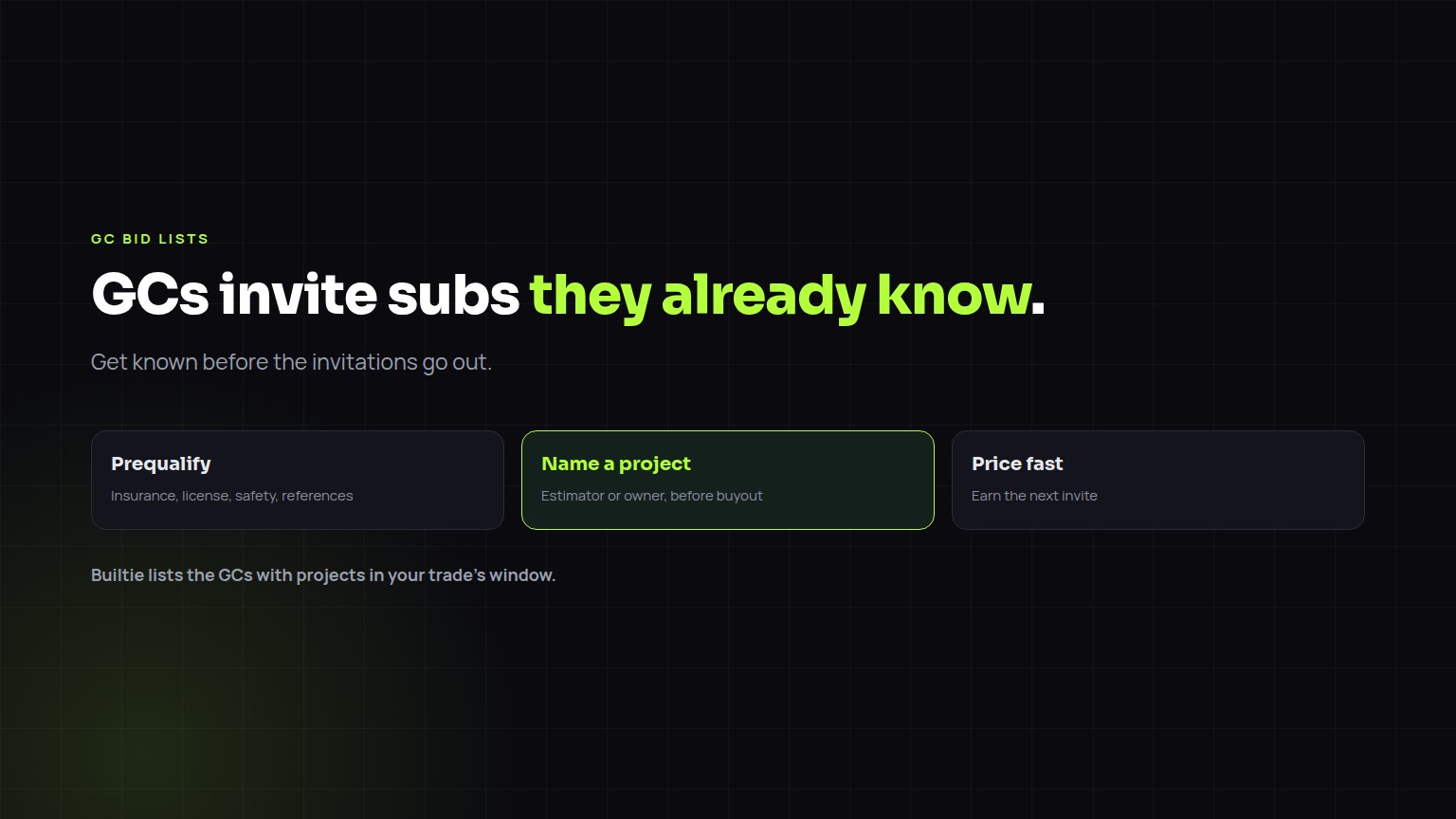
You get on a general contractor's bid list by prequalifying with them before they need you: send the documents they ask every sub for (insurance, license, safety record, references, bonding capacity if commercial), then reach the estimator or preconstruction manager with a short note tied to a project they are pursuing. GCs invite subs they already know. The project data tells you which GCs to start with: the ones with permitted projects at the stage your trade is about to be bought.
The same four steps, whether the buyer is a builder, a designer, an owner or a company you want to acquire.
What GCs check before they invite you
- Certificate of insurance and license for your trade and state.
- Safety record (EMR and OSHA logs on commercial work).
- Bonding capacity, for commercial and public work.
- Three references from GCs or builders, with similar job sizes.
- A one-page capability sheet: trade, crew size, typical job size, service area.
Who to contact
| GC size | Who keeps the bidder list | Best first touch |
|---|---|---|
| Small GC or custom builder | The owner | A call or LinkedIn message naming their current job |
| Mid-size commercial GC | Chief estimator or preconstruction manager | Prequalification form plus a short email |
| Large GC | Preconstruction and subcontractor prequalification team | Their online prequal portal, then the estimator on a named project |
The sequence
Most subs stop at step 2.
Next: How to follow up on a construction bid, Construction sales email templates, Why bid boards put you against every competitor.
Plans and coverage
Builtie's Starter plan is $79 per seat per month (CAD) for 20 projects; Growth is $99 for 50 projects and adds the LinkedIn and email outreach you run yourself. Opening a project spends one credit, and the decision makers, emails, phones and AI call script inside it are included. Your monthly credits reset at each renewal, and extra credit packs are valid for 30 days. The free trial runs 7 days with 10 projects. Custom, where Builtie's team runs the outreach for you, starts from CAD $1,500 a month on top of a Growth seat.
Builtie covers North America, with its deepest permit and contact data in the Greater Toronto Area, where it started. How much a city yields depends on what that municipality publishes, so ask for live sample projects in your own city before you buy.
Frequently asked questions
How do I get on a general contractor's bid list?
Prequalify before you are needed (insurance, license, safety record, references, bonding if commercial), then contact the estimator or preconstruction manager about a specific project they are pursuing.
Who decides which subcontractors are invited to bid?
At a small builder, the owner. At a commercial GC, the chief estimator or preconstruction team, who keep the bidder list per trade.
How much does Builtie cost?
Starter is $79 per seat per month (CAD) for 20 projects; Growth is $99 for 50 projects plus LinkedIn and email outreach; 7-day free trial with 10 projects. Billed monthly.