Why Bid Boards Put You in Front of Every Competitor at Once, and Where the Uncontested Work Is
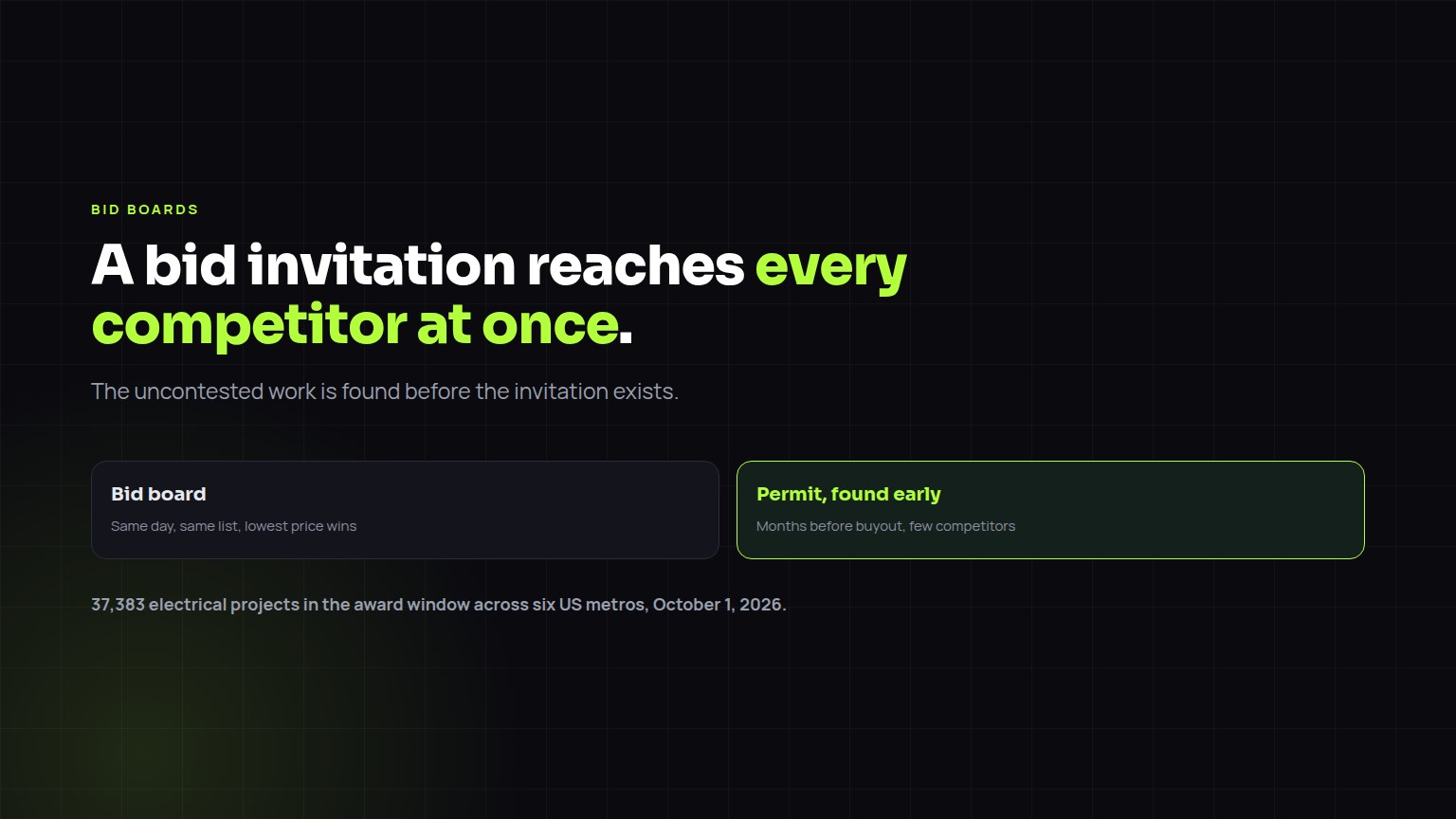
A bid board is the last place a project appears, not the first. When a general contractor sends an invitation through a bid network, every subcontractor on that list gets it the same day, and the job goes to whoever is cheapest by the due date. The work that is not contested is found earlier: from the building permit, before buyout, by reaching the GC's estimator or the builder's owner directly. On October 1, 2026 Builtie held 37,383 projects in the electrical award window across six US metros, 25,075 of them permitted in the last 90 days.
The same four steps, whether the buyer is a builder, a designer, an owner or a company you want to acquire.
What a bid board actually gives you
| Bid board invitation | Permit, found early | |
|---|---|---|
| When you hear about it | At bid time, days before the due date | When the permit issues, months before buyout |
| Who else hears | Every sub on the GC's list | Whoever did the research |
| What decides it | Price, on a deadline | Relationship, scope, availability, then price |
| Who you talk to | Nobody until the bid is in | The estimator, PM or owner, before buyout |
Keep the bid board. Stop depending on it.
Bid networks such as BuildingConnected and PlanHub are how many GCs send invitations, and public work runs through formal bid portals. Stay on them. The problem is a pipeline made only of invitations: you only ever see contested work. Add a source that reaches you before the invitation exists.
Builtie does steps 1 to 4 for you.
Read next: How to get on a general contractor's bid list and How to follow up on a construction bid.
Plans and coverage
Builtie's Starter plan is $79 per seat per month (CAD) for 20 projects; Growth is $99 for 50 projects and adds the LinkedIn and email outreach you run yourself. Opening a project spends one credit, and the decision makers, emails, phones and AI call script inside it are included. Your monthly credits reset at each renewal, and extra credit packs are valid for 30 days. The free trial runs 7 days with 10 projects. Custom, where Builtie's team runs the outreach for you, starts from CAD $1,500 a month on top of a Growth seat.
Builtie covers North America, with its deepest permit and contact data in the Greater Toronto Area, where it started. How much a city yields depends on what that municipality publishes, so ask for live sample projects in your own city before you buy.
Frequently asked questions
Are construction bid boards worth it?
For public work and for GCs that only buy through invitations, yes. But every invited sub sees the same job on the same day, so bid boards alone produce price competition. Add an earlier source such as permits.
How do subcontractors find work that isn't on bid boards?
From building permits, before buyout, by contacting the GC's estimator or project manager or the builder's owner directly. Builtie lists those projects with the decision maker attached.
How much does Builtie cost?
Starter is $79 per seat per month (CAD) for 20 projects; Growth is $99 for 50 projects plus LinkedIn and email outreach; 7-day free trial with 10 projects. Billed monthly.