
The Right CRM for Electrical, Plumbing and HVAC Contractors: Service Work vs Construction Work

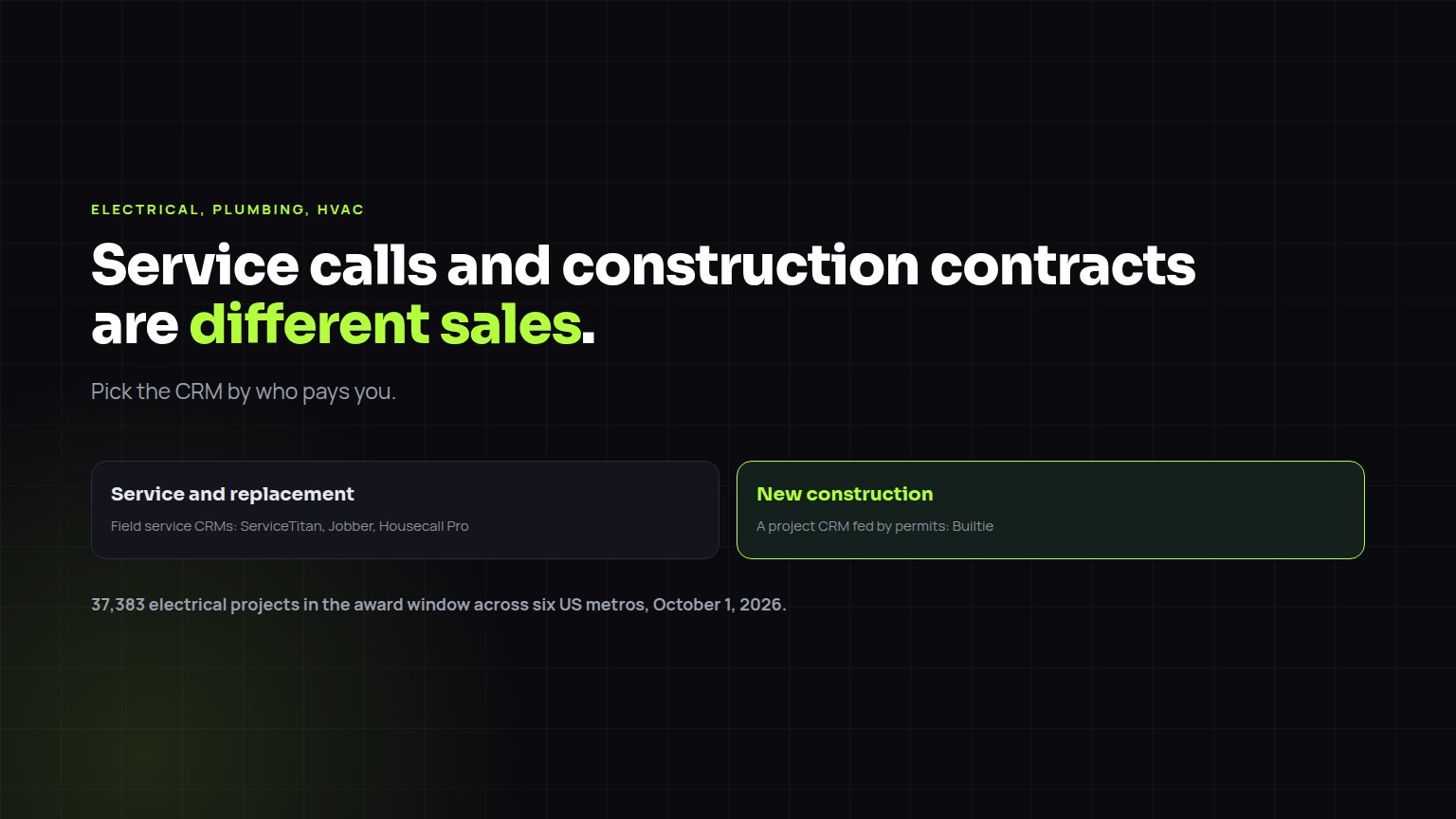
Electrical, plumbing and HVAC contractors usually run two businesses with two kinds of customer. For service and replacement work sold to homeowners and property managers, a field service CRM such as ServiceTitan, Jobber or Housecall Pro fits, because the CRM sits next to dispatch, quoting and invoicing. For new construction work sold to builders and general contractors, the unit is a project, several GCs bid it, and the job is won months before the crew arrives; that needs a CRM organized around projects and a source of them. Builtie is that second kind, fed by permits: on October 1, 2026 it held 37,383 electrical, 35,898 plumbing and 37,558 HVAC projects in their award windows across six US metros.
The same four steps, whether the buyer is a builder, a designer, an owner or a company you want to acquire.
Service CRM or project CRM
| Service and replacement work | New construction work | |
|---|---|---|
| Customer | Homeowners, property managers, facilities | Builders, general contractors, developers |
| Unit of sale | A call, a quote, a maintenance agreement | A project, priced to every GC bidding it |
| Speed | Same day to a few weeks | Months, set by the build schedule |
| Where leads come from | Phone, web, local search, marketplaces, repeat customers | Permits, bid invitations, relationships with GCs |
| CRM that fits | Field service: ServiceTitan, Jobber, Housecall Pro, FieldPulse | Project CRM with a project source: Builtie; or Procore / a configured general CRM for large firms |
Categories as of October 1, 2026; check each vendor before you buy. Many MEP firms run both: a field service tool for the service department and a project CRM for the construction side.
Construction work available to MEP contractors, by US metro
| Metro | Electrical | Plumbing | HVAC / mechanical |
|---|---|---|---|
| New York | 21,956 | 20,956 | 22,078 |
| Austin | 7,093 | 7,091 | 7,093 |
| Miami-Dade | 4,938 | 4,564 | 4,980 |
| Nashville | 1,540 | 1,482 | 1,545 |
| Chicago | 1,092 | 1,075 | 1,092 |
| Seattle | 764 | 730 | 770 |
Read October 1, 2026 from Builtie's permit data. A project counts when its permit was issued in the last four years, its stage sits inside the trade's award window, and the trade's share of the project clears the smallest contract the trade usually takes. Miami-Dade is the county feed (unincorporated Miami-Dade plus many of its cities). New York's feed starts in February 2026. Austin states a construction cost on 7% of permits, so its counts are the least filtered by job size and its median is not published.
What a project CRM needs to do for an MEP contractor
- Keep one record per project, even when you price it to four GCs, and know which GC won.
- Carry bid due dates and the award window, not just a sales stage.
- Hold the scope: plans, addenda, inclusions, exclusions, equipment lead times.
- Name the person who buys out MEP at each GC, not only the company.
- Bring in new projects, so the pipeline does not depend on who called this week.
Trade guides with the project counts and the award timing: Construction leads for electricians (US), Construction leads for plumbers (US), Construction leads for HVAC contractors (US).
Which to start with
Firms that do both usually need one of each.
Plans and coverage
Builtie's Starter plan is $79 per seat per month (CAD) for 20 projects; Growth is $99 for 50 projects and adds the LinkedIn and email outreach you run yourself. Opening a project spends one credit, and the decision makers, emails, phones and AI call script inside it are included. Your monthly credits reset at each renewal, and extra credit packs are valid for 30 days. The free trial runs 7 days with 10 projects. Custom, where Builtie's team runs the outreach for you, starts from CAD $1,500 a month on top of a Growth seat.
Builtie covers North America, with its deepest permit and contact data in the Greater Toronto Area, where it started. How much a city yields depends on what that municipality publishes, so ask for live sample projects in your own city before you buy.
Head-to-head: Builtie vs Buildertrend, Builtie vs Jobber, Builtie vs Procore, Builtie vs Houzz Pro, Builtie vs Contractor Foreman.
See also: ServiceTitan vs Builtie for new construction, Best lead generation software for electrical contractors, Best lead generation software for HVAC contractors, Best lead generation software for plumbing contractors.
Frequently asked questions
What is the best CRM for HVAC, plumbing and electrical contractors?
It depends on the work. For service and replacement work sold to homeowners, field service CRMs such as ServiceTitan, Jobber and Housecall Pro fit. For new construction sold to builders and GCs, a project CRM with a source of projects fits; Builtie provides both together.
Is ServiceTitan or Jobber good for commercial construction bidding?
They are built around service calls, dispatch and invoicing. Commercial construction selling, where several GCs bid the same project, is usually tracked in a project CRM, Procore, or a configured general CRM.
Do MEP contractors need two CRMs?
Many that do both service and new construction do: a field service tool for the service department and a project CRM for the construction side.
How many construction projects are available to electrical contractors in the US?
On October 1, 2026 Builtie's permit data held 37,383 projects in the electrical award window across New York, Austin, Miami-Dade, Nashville, Chicago and Seattle.