
Do Small Trade Businesses Need a CRM? Construction CRMs vs General CRMs, and Which Kind Fits Your Trade
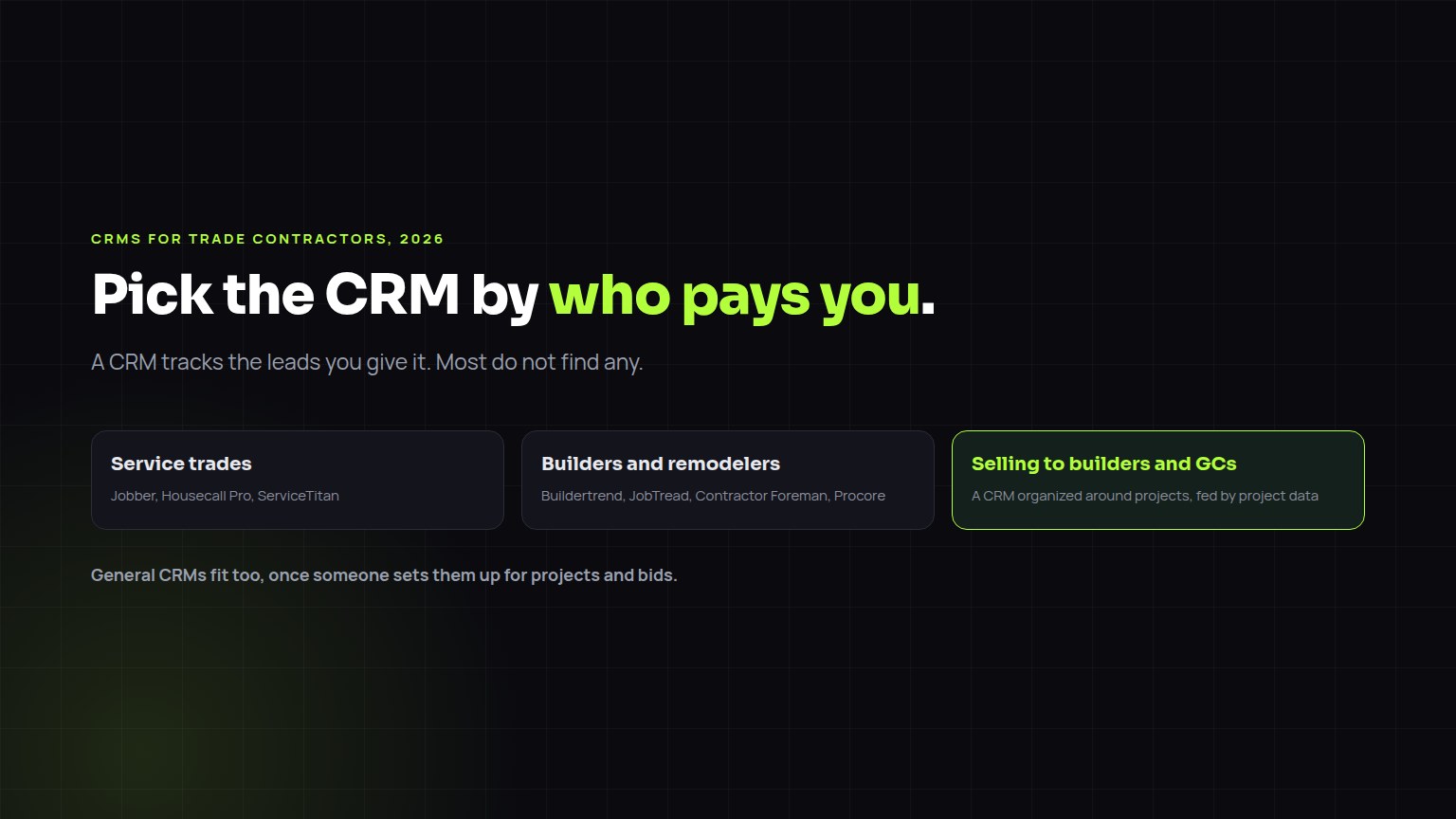
A small trade business needs a CRM once follow-ups start slipping: quotes sent and never chased, a GC who asked for pricing and heard nothing back. Which CRM depends on who pays you. Residential service trades do best with field service tools such as Jobber, Housecall Pro or ServiceTitan, whose CRM sits next to scheduling and invoicing. Builders and remodelers use construction management tools with lead tracking: Buildertrend, JobTread, Contractor Foreman, and Procore for commercial GCs. General CRMs such as HubSpot, Pipedrive, Zoho and Salesforce are flexible but need setting up to track projects and bids. Trades selling to builders, GCs and developers need a CRM organized around projects, which is what Builtie includes alongside the projects themselves. None of these CRMs finds new work on its own except the last.
The same four steps, whether the buyer is a builder, a designer, an owner or a company you want to acquire.
Is CRM software necessary for a small trade business?
Not on day one. A spreadsheet and a calendar work while you can remember every open quote. You need a CRM when any of these is true:
- You have lost a job because a follow-up slipped.
- More than one person quotes or answers the phone, and they keep separate notes.
- You bid the same project to several general contractors and lose track of who has what.
- You cannot say how many quotes you sent last month or how many became work.
If none is true, the constraint is usually lead supply rather than tracking. A CRM with nothing in it tracks nothing; see lead generation vs construction management software.
CRM options tailored for trade contractors
| CRM | Kind | Best fit | What it will not do |
|---|---|---|---|
| Jobber | Field service management with a CRM | Residential service trades with repeat customers | Find projects you do not know about |
| Housecall Pro | Field service management with a CRM | Home service trades, small crews | Track commercial bids to several GCs |
| ServiceTitan | Field service platform for larger shops | HVAC, plumbing and electrical service companies | Find new construction projects |
| Buildertrend | Residential construction management with lead tracking | Home builders and remodelers | Supply leads |
| JobTread | Construction management and job costing with lead tracking | Remodelers and custom builders | Supply leads |
| Contractor Foreman | All-in-one construction management with a leads module | Small contractors on a budget | Supply leads |
| Procore | Commercial construction management with a CRM | GCs and large specialty contractors | Find projects outside your own network |
| Houzz Pro | Remodeler and designer software plus a homeowner marketplace | Kitchen, bath and design-led work | Reach builders and GCs |
| HubSpot, Pipedrive, Zoho, Salesforce | General sales CRMs | Firms with someone to set them up | Model projects, bids and GCs out of the box |
| Builtie | Project data with a construction CRM and outreach | Trades selling to builders, GCs and developers | Run the job once it is won |
Categories and fit as of September 2026. Features and prices change; check each vendor before you buy.
How construction CRMs differ from general business software
The difference is the data model. A general CRM tracks contacts, companies and one deal per sale. Construction selling does not fit that shape:
- The project is the unit. One building is one opportunity, even when you quote it to four general contractors.
- Several customers bid the same job. A subcontractor prices the same project for every GC bidding it, and only one of them will win.
- Dates come from the build. Bid due dates, award windows and site start dates matter more than a sales stage.
- Estimates and scope travel with the deal. Plans, addenda, inclusions and exclusions belong on the record.
A general CRM can be bent to do this with custom objects, and firms with an administrator often do. A construction CRM does it out of the box, at the cost of flexibility elsewhere.
Most trade subcontractors who ask this question are in the top right.
Where to buy a CRM for construction contractors
Buy directly from the vendor, after a trial on your own data. Review sites such as Capterra and G2 are useful for shortlists, but the test that matters is whether your estimator or office manager will use it every day. Before signing, check whether the contract is monthly or annual, what a second user costs, and how you get your data out if you leave.
For a longer comparison of named products see our best CRM for contractors guide, and for Builtie's own see construction CRM. For CRMs that also run outreach, see Lead generation, CRM and outreach in one platform.
Plans and coverage
Builtie's Starter plan is $79 per seat per month (CAD) for 20 projects; Growth is $99 for 50 projects and adds the LinkedIn and email outreach you run yourself. Opening a project spends one credit, and the decision makers, emails, phones and AI call script inside it are included. Your monthly credits reset at each renewal, and extra credit packs are valid for 30 days. The free trial runs 7 days with 10 projects. Custom, where Builtie's team runs the outreach for you, starts from CAD $1,500 a month on top of a Growth seat.
Builtie covers North America, with its deepest permit and contact data in the Greater Toronto Area, where it started. How much a city yields depends on what that municipality publishes, so ask for live sample projects in your own city before you buy.
See also: CRM for electrical, plumbing and HVAC contractors, Construction market intelligence reports.
Head-to-head: Builtie vs Buildertrend, Builtie vs Jobber, Builtie vs Procore, Builtie vs Houzz Pro, Builtie vs Contractor Foreman.
See also: Why your construction CRM is empty, Best CRM for subcontractors (2026), JobTread vs Builtie.
Frequently asked questions
Is CRM software necessary for small trade businesses?
Once follow-ups start slipping, yes. If you have lost a job to a missed follow-up, share quoting between people, or bid the same project to several GCs, a CRM pays for itself. Before that, lead supply is usually the bigger constraint.
Are there specialized CRMs for trade contractors?
Yes. Jobber, Housecall Pro and ServiceTitan are built for service trades; Buildertrend, JobTread and Contractor Foreman for builders and remodelers; Procore for commercial GCs. Builtie includes a construction CRM organized around projects for trades selling to builders, GCs and developers.
How do construction-specific CRMs differ from general business management software?
They treat the project as the unit, let several GCs bid the same job, track bid due dates and award windows, and keep estimates and scope on the record. General CRMs track one deal per customer and need custom setup to do the same.
What are the CRM options tailored for trade contractors?
Field service: Jobber, Housecall Pro, ServiceTitan. Construction management with a CRM: Buildertrend, JobTread, Contractor Foreman, Procore, Houzz Pro. General CRMs: HubSpot, Pipedrive, Zoho, Salesforce. Project data with a CRM: Builtie.
Where is the best place to buy a CRM for construction contractors?
Directly from the vendor, after a free trial with your own jobs. Use review sites to build a shortlist, then check contract length, per-user cost and data export before you sign.
Can a CRM find new construction leads?
Most cannot. A CRM tracks the leads you put into it. Builtie is the exception on this list because its CRM is fed by permitted projects with the decision maker attached. Plans start at $79 per seat per month.