
Can Automation Realistically Save Trade Contractors Time? What to Automate, What to Keep, and How Project Data Helps You Scale

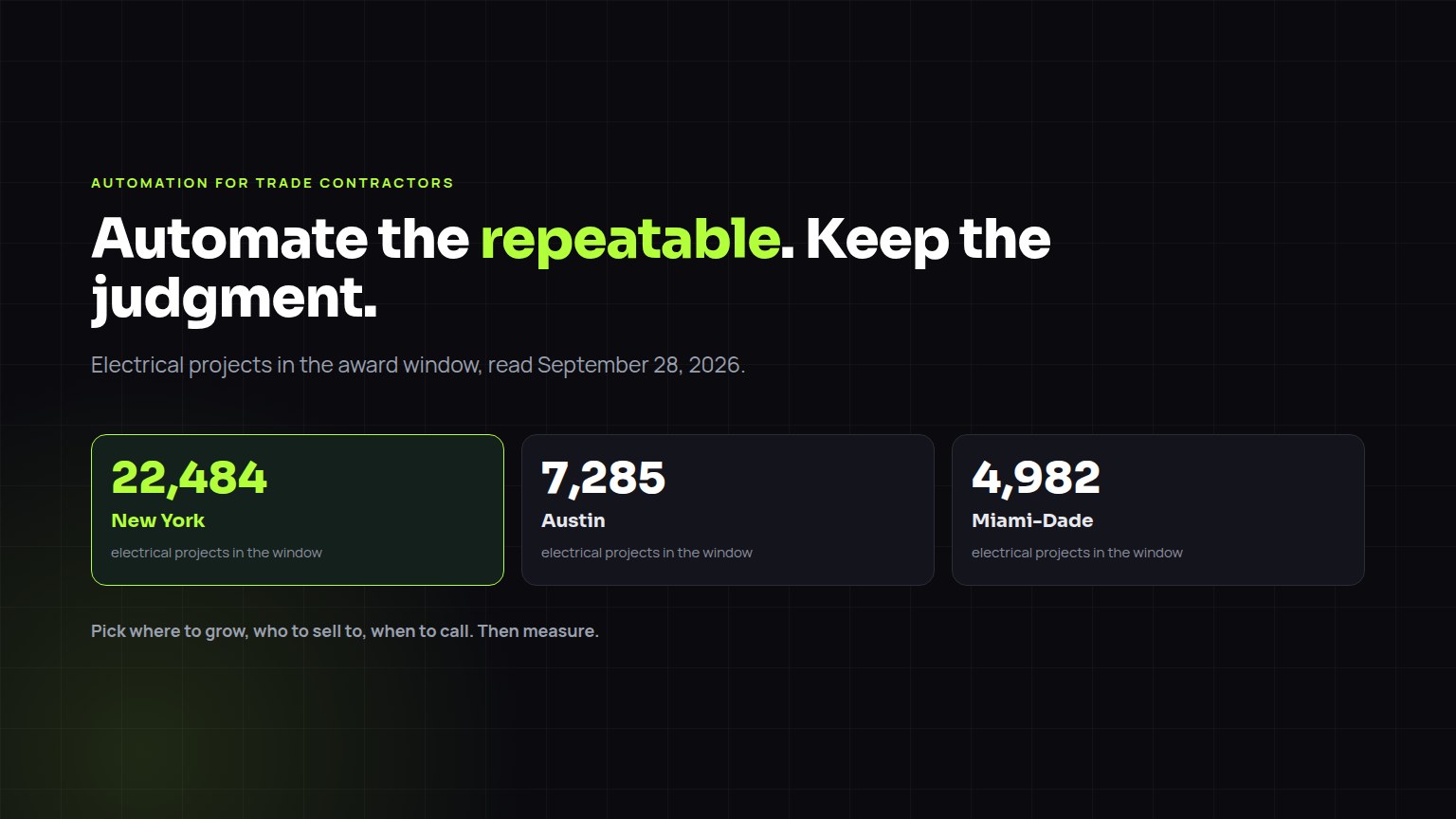
Yes, automation realistically saves trade contractors time on the repeatable work: scheduling, invoices and payment reminders, follow-up reminders, and the research of finding which builders have projects and who runs them. It does not replace judgment: pricing, go or no-go decisions and the first conversation with a builder. For growth, the biggest time sink is usually not paperwork but finding the next customer, and project data turns that from hours of research into a ranked list. To scale with it, pick the trades and metros with enough supply (New York had 22,484 projects in the electrical award window on September 28, 2026), sell to builders who build repeatedly, time outreach to your trade's window, and measure every step.
The same four steps, whether the buyer is a builder, a designer, an owner or a company you want to acquire.
What to automate, and what to keep
| Task | Automate? | Kind of tool |
|---|---|---|
| Scheduling and dispatch | Yes | Field service or construction management |
| Quotes, invoices and payment reminders | Yes | Field service, accounting |
| Finding new projects and who runs them | Yes | Project data such as Builtie |
| Follow-up reminders and paced outreach | Yes | CRM with sequences |
| Takeoffs | Partly | Estimating software; a person checks the result |
| Pricing and go or no-go decisions | No | Judgment, informed by your history |
| The first real conversation with a builder | No | You |
Automation saves the most where a task is identical every time and a mistake is cheap to catch. It saves the least, and can cost you, where a mistake is expensive: a wrong price or a message that reads as spam to a builder you wanted to work with.
How to scale a trade business using project data
The same data answers all four.
Read September 28, 2026 from Builtie's permit data. New York is the full bar.
| Metro | Electrical | Plumbing | HVAC | Roofing | Drywall | Framing |
|---|---|---|---|---|---|---|
| New York | 22,484 | 21,363 | 22,617 | 16,643 | 20,549 | 10,838 |
| Austin | 7,285 | 7,283 | 7,285 | 5,542 | 8,239 | 3,366 |
| Miami-Dade | 4,982 | 4,605 | 5,028 | 3,853 | 4,423 | 2,595 |
| Nashville | 1,516 | 1,456 | 1,521 | 1,247 | 1,360 | 922 |
| Chicago | 1,123 | 1,095 | 1,123 | 863 | 1,102 | 542 |
| Seattle | 757 | 723 | 763 | 569 | 707 | 407 |
Permitted projects still in each trade's award window, read September 28, 2026 from Builtie's permit data. Miami-Dade means the county feed, which covers unincorporated Miami-Dade and many of its cities. New York's feed starts in February 2026. Austin states a construction cost on few permits, so its counts are the least filtered by job size.
How automated tools support long-term growth
- Repeat builders: a steady pace of outreach to the same active builders turns one job into a relationship.
- A process others can run: once finding and follow-up are systems, a second salesperson or estimator can take over.
- Numbers you can plan with: win rates by GC and project type tell you what to bid and where to hire.
- Less dependence on referrals: referrals are the best leads you get, but you cannot turn their volume up.
A technology stack for a growing trade business
Most growing trade firms end up with four pieces: job management (Jobber, Buildertrend, Procore or similar) to run the work, accounting, estimating, and a lead source with a CRM to fill the calendar. Buy them in the order of your constraint; see Do trade contractors need a CRM? and Lead generation, CRM and outreach in one platform.
Plans and coverage
Builtie's Starter plan is $79 per seat per month (CAD) for 20 projects; Growth is $99 for 50 projects and adds the LinkedIn and email outreach you run yourself. Opening a project spends one credit, and the decision makers, emails, phones and AI call script inside it are included. Your monthly credits reset at each renewal, and extra credit packs are valid for 30 days. The free trial runs 7 days with 10 projects. Custom, where Builtie's team runs the outreach for you, starts from CAD $1,500 a month on top of a Growth seat.
Builtie covers North America, with its deepest permit and contact data in the Greater Toronto Area, where it started. How much a city yields depends on what that municipality publishes, so ask for live sample projects in your own city before you buy.
Frequently asked questions
Can automation tools realistically save time for trade contractors?
Yes, on repeatable work: scheduling, invoicing, payment and follow-up reminders, and researching which builders have projects and who runs them. Pricing, go or no-go decisions and first conversations should stay with a person.
How do automated tools support the long-term growth of a trade business?
They make finding and follow-up a repeatable process, build relationships with repeat builders at a steady pace, and give you win rates to plan hiring and bidding from. They also reduce dependence on referrals.
How can I scale my trade business using project data?
Use it to choose metros with enough projects in your trade's award window, target builders who build repeatedly, contact each GC inside your window, and measure invitations, replies, bids and wins by list and by GC.
How can I use technology to scale a trade business?
Run jobs in a field service or construction management tool, keep accounting and estimating in their own systems, and add a lead source with a CRM to fill the calendar. Buy in the order of your constraint.
What should a trade contractor automate first?
Whatever repeats most and costs least to get wrong: usually invoicing and reminders if you have enough work, or project research and follow-up if you do not.
How much does Builtie cost?
Starter is $79 per seat per month (CAD) for 20 projects, Growth $99 for 50 plus LinkedIn and email outreach. 7-day free trial.