
Lead Management for Estimators: One Queue for New Projects, Bid Invitations and Follow-Ups Across Every Trade You Run

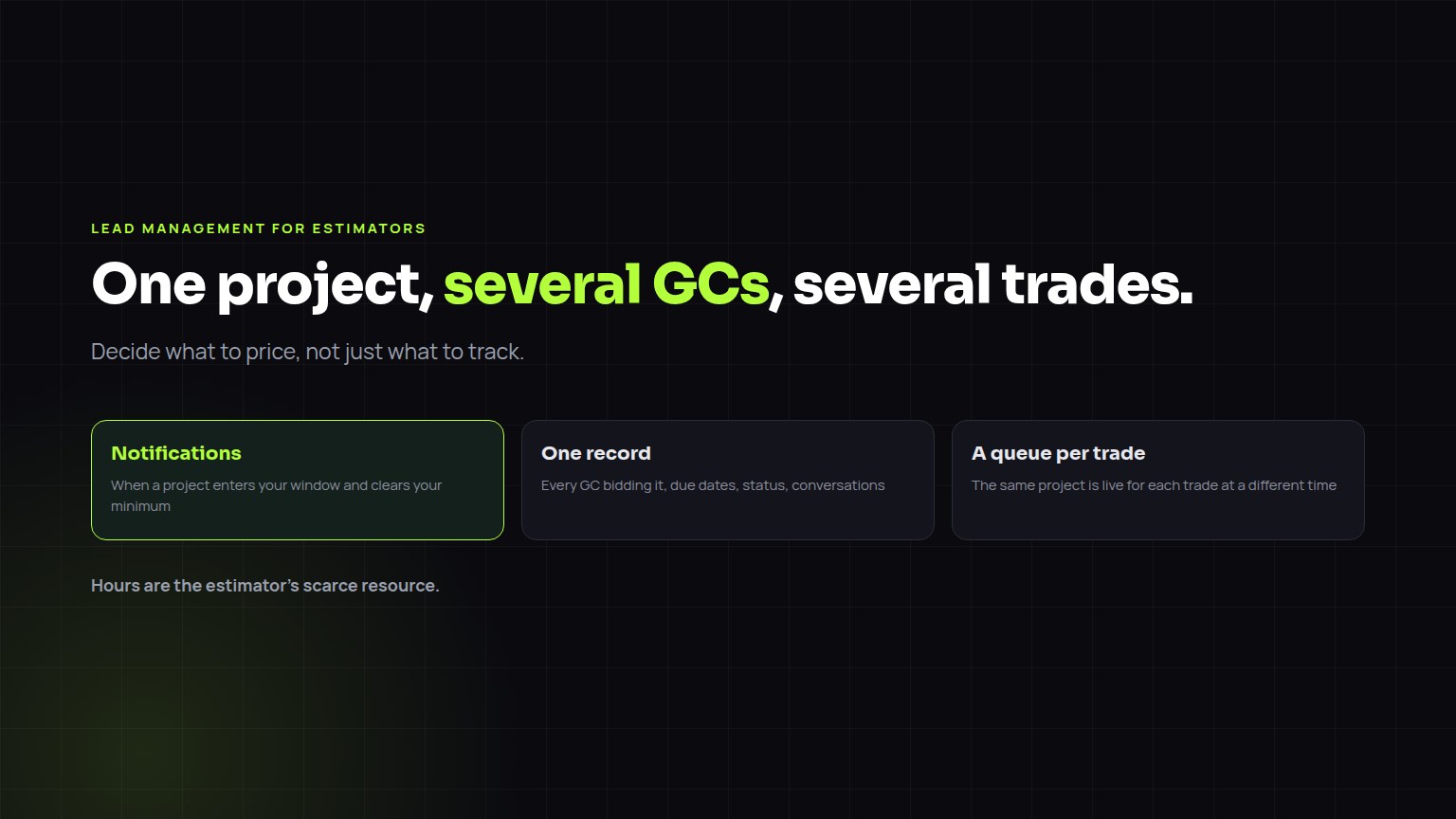
An estimator's scarce resource is hours, so lead management for estimators is deciding which projects to price. Three things make that easier. Automated notifications that fire when a project in your territory enters your trade's award window and clears your minimum job size, rather than on every permit. One record per project that carries every general contractor bidding it, each bid's due date and status, and the outreach history, so the sales side and the estimating side read the same page. And for firms running several sub-trades, a queue per trade, because the same project reaches electrical, drywall and flooring months apart.
The same four steps, whether the buyer is a builder, a designer, an owner or a company you want to acquire.
Benefits of automated lead notifications for estimators
- Fewer projects to read. Filtered by trade, territory and minimum job size, a notification is a candidate, not a permit dump.
- An earlier start. A project flagged at the start of your window leaves weeks to get on the GC's bid list.
- No missed due dates. Bid dates on the project record, with reminders, instead of in an inbox.
- A reason to call. A stage change or a new permit on a known project is a natural follow-up.
Benefits of centralizing outreach and CRM data for estimators
When sales and estimating keep separate notes, the estimator prices a job the salesperson already knows is lost, or the salesperson chases a GC the estimator has already declined. Centralizing puts four things on one record: the project and its stage, every GC bidding it, the people you have talked to and what they said, and your bid status with each GC. Win rates by GC, by project type and by size then come from the record rather than from memory.
Managing multiple project bids
A subcontractor usually prices the same project for several general contractors, and only one of them wins the job. Track the project once and the bids under it, not a separate deal per GC. Bid invitation platforms such as BuildingConnected, PlanHub and Procore's bid management carry invitations from GCs who use them; a project source such as Builtie adds the projects no one has invited you to yet. Whatever holds the list, the rules are the same:
- Decide go or no-go within a day of an invitation, using size, GC relationship and current backlog.
- Keep scope, inclusions and exclusions consistent across every GC's version of the bid.
- Log the result and the winning number when you can get it, for every bid.
Lead management for multiple sub-trades
From Builtie's trade windows on a typical $2 million build.
A firm that runs electrical and drywall, or plumbing and HVAC with finishes, sees the same project become live for each trade at a different time and at a different size threshold. Keep one queue per trade with its own window and minimum, and link them to the same project so the GC hears one voice.
| Trade | Smallest job worth quoting (dollars) | Award window |
|---|---|---|
| Framing | 15,000 | 0% to 30% |
| Roofing | 8,000 | 15% to 45% |
| Electrical | 5,000 | 20% to 55% |
| Plumbing | 5,000 | 20% to 55% |
| HVAC / mechanical | 6,000 | 20% to 55% |
| Drywall | 5,000 | 35% to 70% |
| Flooring | 5,000 | 50% to 80% |
| Painting | 3,000 | 50% to 85% |
Minimums and windows from Builtie's trade model, read September 28, 2026. A project that is worth pricing for framing may be too small to matter for painting, and the other way round.
Plans and coverage
Builtie's Starter plan is $79 per seat per month (CAD) for 20 projects; Growth is $99 for 50 projects and adds the LinkedIn and email outreach you run yourself. Opening a project spends one credit, and the decision makers, emails, phones and AI call script inside it are included. Your monthly credits reset at each renewal, and extra credit packs are valid for 30 days. The free trial runs 7 days with 10 projects. Custom, where Builtie's team runs the outreach for you, starts from CAD $1,500 a month on top of a Growth seat.
Builtie covers North America, with its deepest permit and contact data in the Greater Toronto Area, where it started. How much a city yields depends on what that municipality publishes, so ask for live sample projects in your own city before you buy.
See also: How to manage multiple construction bids, How to follow up on a construction bid.
Frequently asked questions
What are the benefits of automated lead notifications for estimators?
Fewer projects to read, an earlier start inside the award window, no missed bid dates, and a natural reason to follow up when a project changes stage. Notifications should be filtered by trade, territory and job size.
What are the benefits of centralizing outreach and CRM data for trade estimators?
Sales and estimating read the same record: the project, every GC bidding it, the conversations and the bid status with each GC. That stops duplicate or wasted estimates and gives win rates by GC and project type.
How do automated tools help in managing multiple project bids?
They track one project with several GC bids under it, carry due dates and reminders, keep scope consistent and record outcomes. Invitation platforms bring bids to you; a project source like Builtie adds projects no one invited you to.
How should a contractor handle lead management for multiple sub-trades?
Keep a queue per trade with its own award window and minimum job size, linked to the same project record so the GC hears one voice.
Does Builtie send new project alerts?
Builtie keeps a daily feed of new projects matching your trade and territory, ranked by how close each is to your trade's buy window.
What does Builtie cost for an estimating team?
Starter is $79 per seat per month for 20 projects, Growth $99 for 50 plus outreach. Each seat is priced separately.