
The Most Active Interior Alteration Contractors in Miami-Dade, H1 2026
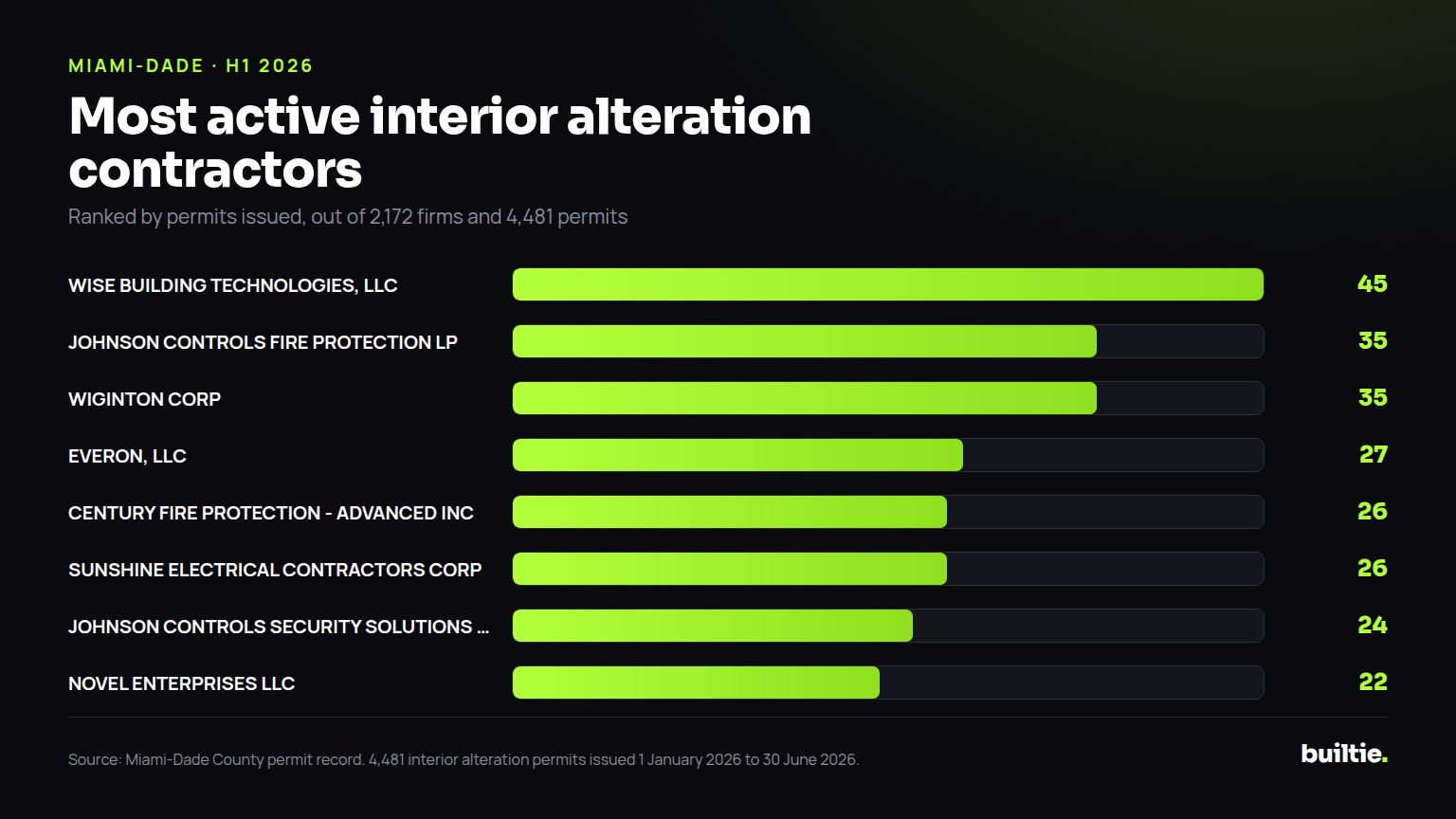
WISE BUILDING TECHNOLOGIES, LLC filed the most interior alteration permits in Miami-Dade in the first half of 2026, with 45 of the 4,481 issued in the period. JOHNSON CONTROLS FIRE PROTECTION LP and WIGINTON CORP follow with 35 and 35. Below is the full ranking, drawn from Miami-Dade County's permit record and counted without weighting.
The same four steps, whether the buyer is a builder, a designer, an owner or a company you want to acquire.
The 25 busiest interior alteration contractors in Miami-Dade
Ranked by the number of interior alteration permits issued to each firm by Miami-Dade County between 1 January and 30 June 2026. Share of work type is that firm's permits as a percentage of all 4,481 interior alteration permits in the period. The table lists every firm with at least 3 permits, up to 25; below that the counts are too close together to separate one firm from the next.
| # | Contractor | Permits | Share of work type | Stated value | Last filed |
|---|---|---|---|---|---|
| 1 | WISE BUILDING TECHNOLOGIES, LLC | 45 | 1.0% | $11.8M | 26 June 2026 |
| 2 | JOHNSON CONTROLS FIRE PROTECTION LP | 35 | 0.8% | $3.2M | 30 June 2026 |
| 3 | WIGINTON CORP | 35 | 0.8% | $4.2M | 23 June 2026 |
| 4 | EVERON, LLC | 27 | 0.6% | $9.8M | 17 June 2026 |
| 5 | CENTURY FIRE PROTECTION - ADVANCED INC | 26 | 0.6% | $599k | 12 June 2026 |
| 6 | SUNSHINE ELECTRICAL CONTRACTORS CORP | 26 | 0.6% | $1000k | 18 June 2026 |
| 7 | JOHNSON CONTROLS SECURITY SOLUTIONS LL | 24 | 0.5% | $217k | 17 June 2026 |
| 8 | NOVEL ENTERPRISES LLC | 22 | 0.5% | $862k | 10 June 2026 |
| 9 | SOUTHERN FIRE CONTROL INC | 22 | 0.5% | $5.4M | 17 June 2026 |
| 10 | INFINITY AT YOUR SERVICE LLC | 19 | 0.4% | $463k | 11 June 2026 |
| 11 | CITY FIRE PROTECTION INC | 18 | 0.4% | $1.7M | 23 June 2026 |
| 12 | BELLA FIRE PROTECTION CORPORATION | 17 | 0.4% | $118k | 25 June 2026 |
| 13 | MILLER ELECTRIC COMPANY | 17 | 0.4% | $28.1M | 30 June 2026 |
| 14 | ALL AROUND FIRE PROTECTION LLC | 16 | 0.4% | $2.0M | 18 June 2026 |
| 15 | AST ELECTRIC INC | 16 | 0.4% | $2.9M | 9 June 2026 |
| 16 | BUILD PRO CONSTRUCTION INC | 16 | 0.4% | $832k | 30 June 2026 |
| 17 | CONVERGINT TECHNOLOGIES LLC | 16 | 0.4% | $2.6M | 30 June 2026 |
| 18 | GULFSTREAM FIRE SPRINKLERS INC | 15 | 0.3% | $228k | 23 June 2026 |
| 19 | PANTHER AIR CONDITIONING & ELECTRIC IN | 15 | 0.3% | $2k | 25 June 2026 |
| 20 | BENETTI SERVICES INC | 14 | 0.3% | $987k | 24 June 2026 |
| 21 | ELECTRICAL MASTERS INC | 14 | 0.3% | $2.0M | 24 June 2026 |
| 22 | PATRIOT FIRE INC | 14 | 0.3% | $2.4M | 10 June 2026 |
| 23 | AMERICAN FIRE SPRINKLER SERVICES LLC | 13 | 0.3% | $103k | 26 June 2026 |
| 24 | D-AIR CONDITIONING COMPANY | 13 | 0.3% | $419k | 2 June 2026 |
| 25 | ENGINEERED SYSTEMS SOLUTIONS LLC | 13 | 0.3% | $413k | 15 June 2026 |
The full field is 2,172 firms. The 25 listed here account for 11.3% of every interior alteration permit issued; the rest is a long tail, and 1,354 of the 2,172 firms filed exactly once in the period.
What counts as interior alteration work here
In this record alter, interior means work inside an existing building: tenant fit-outs, restaurant and retail build-outs, office remodels, condo interiors, and the strip-out and rebuild that precedes them.
This is the most fragmented work type in the county and the most competitive. The busiest firm holds well under one permit in twenty, so a strategy built on the top of this table reaches a small minority of the work. The table is more useful here as a set of named accounts to open than as a market map.
How concentrated this work type is
Bars are scaled to the busiest firm. The percentage is that firm's share of every interior alteration permit issued in the period.
This is a fragmented work type. Ten firms out of 2,172 hold only 6.3% of the permits, so a strategy built on the top of the table reaches a small minority of the work. The busiest single firm holds 1.0% on its own, and 62% of the 2,172 firms in the record filed exactly one permit in the period, which is the usual shape of a permit long tail: a small number of production contractors, and a large number of firms doing occasional or single-property work.
Volume and value are two different rankings
Ranked by the construction value declared on that firm's own permits, not by how many it filed. The permit count is shown beside each figure.
The two rankings barely overlap, and that is the point. MILLER ELECTRIC COMPANY tops this list with $28.1M across 17 permits, while WISE BUILDING TECHNOLOGIES, LLC, the busiest firm by count, filed 45 permits worth $11.8M. Neither is bigger than the other; one does many small jobs and one does few large ones. Decide which you sell to before you work either list.
Month by month
Every interior alteration permit issued in the period, by month of issue. The busiest month is highlighted.
Jun was the busiest month with 838 permits and Feb the quietest with 665, a spread of 26%. That is a real swing across the half, worth knowing before you read one month as a trend. A single month is a small sample in any case: use the run rate to judge whether a firm has gone quiet, not to call the market.
What a permit count measures, and what it does not
A permit count is a measure of filing frequency. It is the closest public proxy for how much work a contractor is currently taking on, and it has the useful property of being impossible to inflate: a permit costs money and creates an inspection obligation, so nobody files one for marketing reasons.
| A high permit count tells you | It does not tell you |
|---|---|
| The firm is actively working and has capacity in use right now | How large the jobs are, beyond the value stated on the permits themselves |
| It is licensed and in good standing, because an unlicensed firm cannot pull the permit | Whether the work was done well, or on time |
| It works in Miami-Dade County, which a company website often overstates | How much of its revenue comes from this county rather than the wider region |
| It is large enough to run permitted work continuously | Headcount, revenue, or whether it is hiring |
| Its work is recent, which the last-filed date shows per firm | What it is bidding next, which no public record contains |
One more limit worth stating plainly: a firm that works under someone else's license does not appear here at all, and a firm that pulls permits on behalf of others appears larger than it is. The record names whoever signed, which is not always whoever did the work.
How to use this list
If you sell to interior alteration contractors
This is a prospect list ordered by demonstrated buying capacity, and it is aimed at cabinetry and millwork shops, flooring, drywall, painting, glazing and fixture suppliers, and anyone selling into commercial fit-out work. A firm filing 45 permits in six months is consuming materials, equipment, labor and subcontracted services continuously, and the permit record proves it in a way a company website cannot. Start at the top, and use the last-filed date to skip anyone who has gone quiet.
If you are a general contractor or developer looking for capacity
Volume is a capacity signal, not a quality one, so treat the ranking as a shortlist to check rather than a recommendation. The firms near the top are demonstrably able to run several permitted jobs at once. Verify license standing and references separately; this page reports what was filed, not how it went.
If you are a interior alteration contractor yourself
This is your competitive set, measured rather than guessed. The share column tells you what a realistic position looks like in the county: the busiest firm holds 1.0% of all interior alteration permits, which means even the leader competes for most of the work.
Where this sits among construction software
A permit ranking is one input, and it is worth being explicit about which category of tool it belongs to and which it does not replace. Construction sales software splits into about eight categories, and most buying mistakes come from expecting one of them to do another's job.
| Software category | What it is built to do | Where it leaves a gap |
|---|---|---|
| Project-data subscriptions | Report projects at scale across regions, with plans and specs attached | Priced for enterprise, and the contact attached is often a records office rather than the person who picks your scope |
| Bid management and invitation platforms | Move an invitation to bid, drawings and addenda between a general contractor and its subs | You have to be invited first, so it works after someone already decided to include you |
| Plan rooms and bid directories | List projects out to bid and let you find drawings for them | Everyone bidding sees the same posting at the same time, which is the definition of a competitive price |
| Public tender portals | Publish government and institutional work with a formal, fair process | Covers only publicly funded work, which is a minority of most trades' revenue |
| Residential lead marketplaces | Sell a homeowner's enquiry, usually to several contractors at once | The same lead is sold more than once, and it is homeowner work rather than commercial projects |
| General B2B sales tools | Find companies and contacts by industry code, headcount and title | They know companies, not projects, so they cannot tell you a building is going up on a specific site this quarter |
| Contractor CRM | Hold your pipeline, quotes and follow-ups once you have someone to talk to | A CRM stores what you put in it; it does not source anything |
| Contact databases | Give you names, emails and phone numbers at construction companies | A contact with no project behind it gives you nothing specific to say |
| Construction sales intelligence | Tie an active project to the people who decide its scope, and time the approach | Depends entirely on the depth of the underlying record in your market, which is worth testing before buying |
A table like the one on this page is raw public record, which is the layer underneath all of those. It tells you who is busy. It does not tell you what is being let next, which is the question that actually produces work, and no permit feed on its own can.
- Construction lead generation platforms in 2026, a category-by-category comparison
- Construction bidding software in 2026, for the estimating and submission side
- The best CRM for contractors, if the gap is pipeline rather than sourcing
- ConstructConnect alternatives and Dodge alternatives, if you are already paying for a subscription and reviewing it
How this ranking was built
Every step is reproducible from the public record. Nothing is weighted, scored or editorially ordered.
The counting is deliberately plain. There is no weighting by job size, no adjustment for permit value, and no editorial ordering. Two firms with the same number of permits are ranked alphabetically, and the only judgment applied anywhere is deciding when two differently punctuated names are the same company.
That last judgment is where the errors would live, so it is made conservatively. Punctuation and spacing are normalized, which merges ARNOLD J. ELECTRIC INC with ARNOLD J ELECTRIC INC. Legal suffixes are not touched, so a firm filing as an Inc and an LLC stays as two entries: they can genuinely be two companies, and merging them would be a worse mistake than leaving them apart.
What this record covers, and what it does not
This record is Miami-Dade County's permit feed, and it is county-wide rather than city-wide. Most of it is the unincorporated county, with the City of Miami and dozens of other municipalities alongside it.
- Every permit carries a county folio number whose first two digits name the municipality. Across the feed there are 37 distinct municipality codes: 81.2% is unincorporated Miami-Dade, 4.5% is the City of Miami proper, and the remaining 13.8% spans 35 more, Miami Beach, Doral, Aventura, Hialeah and Homestead among them.
- So a firm that works across the county is represented here, not just one that works downtown. The reverse caution still applies at the edges: a municipality that runs its own building department and files nothing through the county will be under-represented, so read a low rank as low volume in this record rather than as low volume overall.
- The feed publishes no neighborhood, postal code or usable coordinate, so there is no honest way to break this down by area. Any page claiming a Brickell or Wynwood permit ranking is inferring it from something other than this record.
- Values pass the same screen the county reports use: a single permit at or above $1B is dropped, and a value of $10M or more repeating across five or more permits is dropped as a parent project total stamped onto its own sub-permits. Without that screen the raw half-year total is $103.7B, most of it a folio number sitting in a cost column.
- Permits filed under OWNER, SELF and similar placeholders are excluded. In this record OWNER alone accounts for more filings than any real company, and leaving it in would put a placeholder at the top of every table.
Permits are a record of work already awarded
Everything above describes work that has already been won. A permit is issued after the contract is signed, which makes this page an excellent map of who is active and a poor list of what to bid on. The buying decision for most trades lands around a third of the way through a build, at framing, well before the trade permit is filed.
That is the distinction Builtie is built around: watch the project record from the planning and permit stage forward, identify the developer or general contractor behind it, and reach the person who decides your scope while the package is still open. When to contact each trade sets out the timing by discipline, and construction leads in Miami-Dade covers what the platform tracks in this market.
Builtie plans start at $79 per month per seat for 20 projects a month, and $99 for 50. Growth adds the LinkedIn and email outreach you run from the platform; Starter does not include Outreach. Done-for-you, where Builtie's team runs the content, campaigns and replies for you, is the Custom plan. There is a 7-day free trial with 10 projects.
The other Miami-Dade rankings
- Most active new construction contractors in Miami-Dade
- Most active exterior alteration contractors in Miami-Dade
- Most active pool and detached addition builders in Miami-Dade
- Most active demolition contractors in Miami-Dade
- Most active electrical contractors, ranked by trade rather than work type
- Most active plumbing contractors
- Most active mechanical and HVAC contractors
- Most active fire protection contractors
Frequently asked questions
Who is the most active interior alteration contractor in Miami-Dade?
WISE BUILDING TECHNOLOGIES, LLC, with 45 interior alteration permits issued in the first half of 2026. That is 1.0% of all 4,481 interior alteration permits in the period. JOHNSON CONTROLS FIRE PROTECTION LP and WIGINTON CORP are next, with 35 and 35.
How many interior alteration contractors are there in Miami-Dade?
2,172 distinct firms were issued at least one interior alteration permit in the period. That is the number actively pulling permits in this record, not the number holding a license, which is larger: a licensed firm that worked only under someone else's permit never appears in a permit record at all.
Is this the City of Miami or all of Miami-Dade County?
The county. Every permit carries a folio number whose first two digits name the municipality, and there are 37 distinct codes in this feed: 81.2% unincorporated Miami-Dade, 4.5% the City of Miami itself, and the rest spread across 35 more including Miami Beach, Doral, Aventura, Hialeah and Homestead. The city proper is a small slice of what is counted here.
Can I see this broken down by neighborhood?
Not from this record, and it is worth knowing why. The city publishes no neighborhood, no postal code and no usable coordinate on these filings, so a Brickell or Wynwood ranking could only be produced by inferring the area from something other than the permit. Inferring it and presenting it as measured would be worse than not publishing it.
Where does this ranking come from?
Every interior alteration permit issued by Miami-Dade County in the period, taken from the public record. Firms are counted by the number of permits naming them, with punctuation normalized so one company is not split across several spellings, and placeholder filings under OWNER or SELF excluded. No weighting, scoring or editorial ordering is applied.
Why does the table stop where it does?
It lists every firm with at least 3 permits, up to 25. Below 3 the counts sit in ties that cannot separate one firm from the next, so extending the table would add rows without adding information.
What is the stated value column?
The construction value declared on that firm's own permits, added up. It passes a screen that drops any single permit at or above $1B and any value of $10M or more repeated across five or more permits, both of which are data-entry artefacts rather than real projects. A firm doing many small jobs ranks high on count and low on value; that is a difference in work type, not in size.
Does a high permit count mean a contractor is good?
No. It means the firm is licensed, active, and running enough permitted work to file frequently. It says nothing about workmanship, schedule or price. Treat the ranking as a shortlist of firms worth checking, and check them.
What kind of software is this, and what does it replace?
The table itself is public record rather than software. As a category, tying an active project to the people who decide its scope is construction sales intelligence, which sits beside project-data subscriptions, bid management platforms, plan rooms, tender portals, lead marketplaces, contact databases and contractor CRM. Each does a different job, and the comparison table on this page sets out which gap each one leaves.
How do I find projects before the permit is filed?
A permit is issued after the contract is awarded, so this page maps who is active rather than what is open to bid. Builtie tracks projects from the planning and permit stage and names the developer, general contractor and specifying designer behind each one. Plans start at $79 per month per seat for 20 projects a month and $99 for 50, with a 7-day free trial that includes 10 projects.