
A Proactive Outreach Sequence for Trade Contractors: How to Follow Up With General Contractors Without Being Ignored

An outreach sequence is proactive when it starts from a project before your trade is awarded, not from a bid invitation after it. It has four traits: it is timed to your trade's award window (electrical and plumbing are usually chosen 20% to 55% of the way through a build, drywall 35% to 70%, flooring 50% to 80%), it names the project in every touch, each follow-up adds something useful rather than repeating the ask, and it stops the moment anyone replies. A sequence that works for general contractors runs about a month: a LinkedIn invitation, a short message after they accept, an email with one specific, one useful follow-up, a phone call, then a pause until their next project.
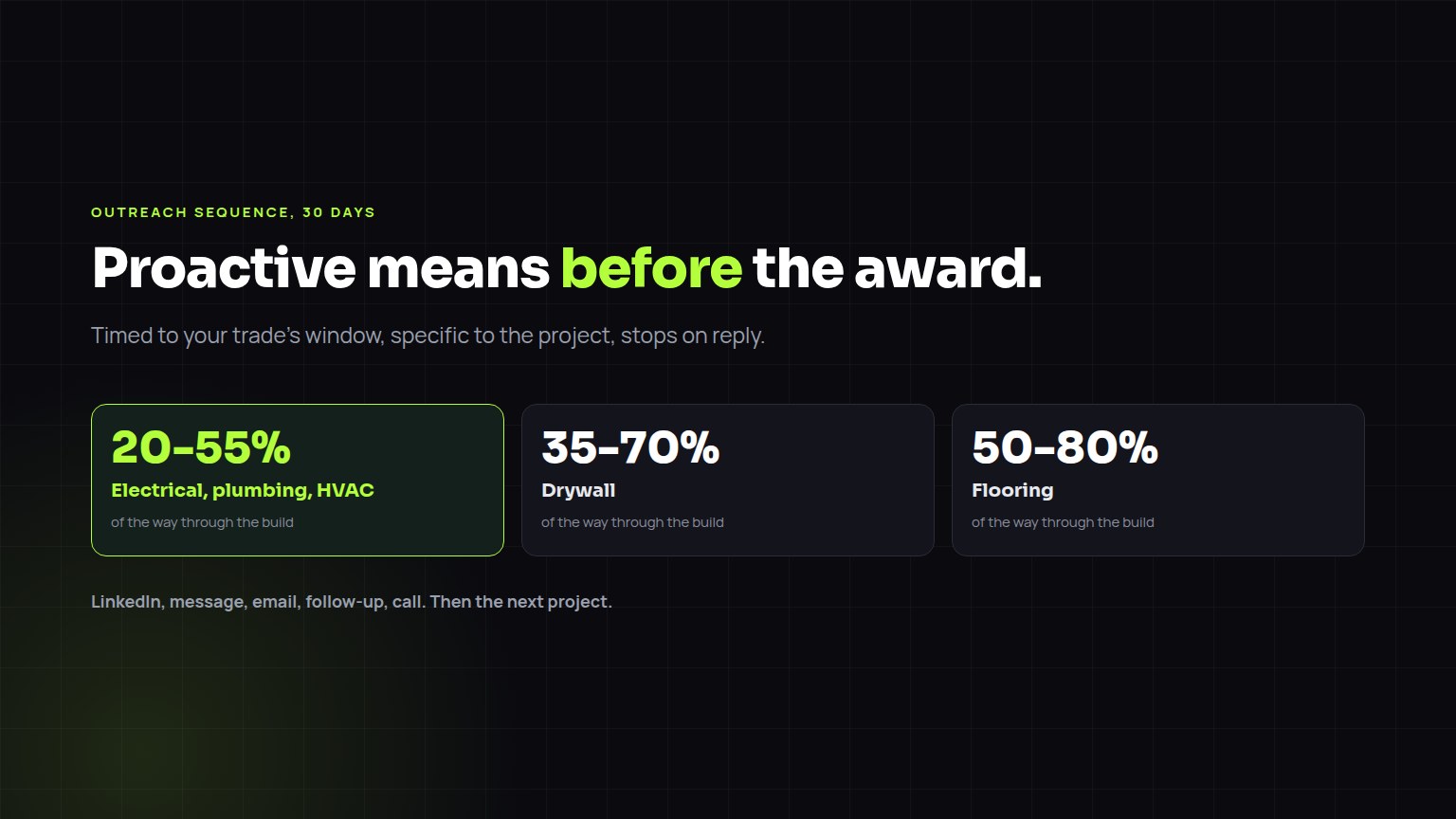
The same four steps, whether the buyer is a builder, a designer, an owner or a company you want to acquire.
When to start: your trade's award window
| Trade | Awarded, as a share of the build | On a $2 million project (about 13 months) |
|---|---|---|
| Concrete / foundation | before the permit to 15% | before the permit to month 2 |
| Framing | 0% to 30% | permit to month 4 |
| Roofing | 15% to 45% | month 2 to 6 |
| Electrical | 20% to 55% | month 3 to 7 |
| Plumbing | 20% to 55% | month 3 to 7 |
| HVAC / mechanical | 20% to 55% | month 3 to 7 |
| Drywall | 35% to 70% | month 5 to 9 |
| Flooring | 50% to 80% | month 7 to 10 |
| Painting | 50% to 85% | month 7 to 11 |
| Landscaping | 65% to 95% | month 8 to 12 |
Windows from Builtie's trade timing model, as a share of total build duration; months are rounded and assume a mid-size project. Cabinetry and millwork are awarded earlier than their install date, around framing, because of 8 to 12 week lead times. Starting after the window closes is not outreach; it is asking for the next job. For the full model see When to contact each trade on a project.
The sequence, touch by touch
Numbers are days from the first touch. Everything stops when they reply.
Tips for emails that get answered
- Subject: the project or street, not your company. "Drywall on 1400 Elm" beats "Partnership opportunity".
- First line: about their job, not about you.
- Proof: one similar project nearby, with the builder's name if you may use it.
- Ask: one question they can answer in a line: who is pricing drywall, and when?
- Length: under 100 words. No attachments until they ask.
A sample first email:
Hi Maria, I saw the permit for the six-story residential at 1400 Elm. We did the drywall and framing on the Oak Street building for Harper Construction last year, about four blocks away. Who is pricing drywall on Elm, and when are bids due? Thanks, Dan— Illustrative, with made-up names
How to automate follow-ups without sounding automated
- Tie each sequence to a project record, so every touch can name the job and its stage.
- Stop on any reply, including out-of-office messages, and route it to a person.
- Pace sends within daily limits per mailbox and per LinkedIn account.
- Let the project's stage, not a fixed calendar, trigger the next attempt: a new permit or a stage change is a reason to write.
- Keep the phone call manual. It is the touch that turns a reply into a bid invitation.
What to expect
Measured across Builtie-run campaigns to September 23, 2026. Acceptance ranged from 9% to 60% between lists.
One meeting request per few hundred invitations sounds low until you count what a builder is worth: a GC who likes your work invites you to the next project, and the one after. Deliverability for the email half is in Keeping sales emails out of spam.
Plans and coverage
Builtie's Starter plan is $79 per seat per month (CAD) for 20 projects; Growth is $99 for 50 projects and adds the LinkedIn and email outreach you run yourself. Opening a project spends one credit, and the decision makers, emails, phones and AI call script inside it are included. Your monthly credits reset at each renewal, and extra credit packs are valid for 30 days. The free trial runs 7 days with 10 projects. Custom, where Builtie's team runs the outreach for you, starts from CAD $1,500 a month on top of a Growth seat.
Builtie covers North America, with its deepest permit and contact data in the Greater Toronto Area, where it started. How much a city yields depends on what that municipality publishes, so ask for live sample projects in your own city before you buy.
See also: Automated construction lead emails, Construction lead quality vs quantity.
See also: Construction sales email templates, How to follow up on a construction bid, Construction outreach benchmarks 2026.
Frequently asked questions
What makes an outreach sequence proactive in the construction sector?
It starts from a project before your trade is awarded, is timed to your trade's award window, names the project in every touch, adds something useful in each follow-up, and stops when anyone replies.
How do I automate follow-ups with general contractors?
Tie each sequence to a project record, pace touches across LinkedIn and email within daily limits, stop on any reply, and let a new permit or stage change trigger the next attempt. Keep phone calls manual.
What are tips for high-converting emails in automated construction sales sequences?
Put the project or street in the subject, open with their job, give one nearby proof point, ask one question, stay under 100 words and send no attachments until asked.
How many times should I follow up with a GC?
Four or five touches over about a month across LinkedIn, email and phone, each adding something new, then pause until their next project.
When should a trade contractor contact a general contractor?
Inside your trade's award window: electrical, plumbing and HVAC about 20% to 55% of the way through the build, drywall 35% to 70%, flooring 50% to 80%. Framing and concrete are chosen at or before the permit.
Can Builtie run this sequence for me?
Growth, at $99 per seat per month, finds the project and person and runs LinkedIn and email outreach from your accounts. Custom has Builtie's team run it, from CAD $1,500 a month on top of a Growth seat.